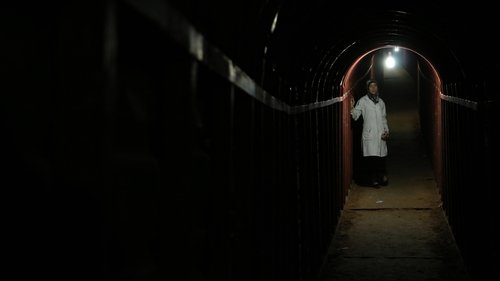





“The Cave” plunges viewers directly into the Syrian conflict from its opening scenes, as director Feras Fayyad did with his previous film, “The Last Men in Aleppo.” The jarring imagery of bombs falling across the landscape, combined with a powerful sound design that conveys the collapse of buildings, immediately establishes the danger faced by civilians. Aerial footage reveals the scope of the crisis stemming from Bashar al-Assad’s rule. Shot between 2016 and 2018, “The Cave” earned the People’s Choice Documentary prize at the 2019 Toronto Film Festival and the Grand Jury Prize at Sundance, where Fayyad focused on the civilian group known as the "White Helmets" in Aleppo. “Last Men in Aleppo” portrays volunteers Khaled, Mahmoud, and Subhi risking their lives daily while navigating treacherous terrain. The film is compelling to watch as these men listen for Russian warplanes overhead and search through rubble to rescue those in need. A particularly poignant moment shows one of the rescuers visiting a young boy he saved; the child regards him with awe, like a superhero possessing magical abilities. The boy repeatedly embraces his rescuer and asks how he managed to save him. The man attempts to remain humble, explaining that God wanted the boy to grow up. Afterward, he confides in a colleague that he felt uncomfortable due to appearing boastful or seeking praise. Feras Fayyad demonstrates a remarkable ability to balance tragic events with moments of tenderness that highlight his subjects’ humanity in “The Cave.” The film takes viewers underground to Al Ghouta, where pediatrician Dr. Amani Ballor struggles to save lives in an improvised hospital carved into a cave. As the leader of a medical team comprising men and women working together, Dr. Ballor embodies a feminist ideal within a conservative Muslim society. She encourages young patients, especially girls, to pursue work that benefits others, urging them to combine intellect and compassion to improve the world. She actively creates opportunities for women to assist their families, but often encounters resistance from those who believe tradition dictates that men disapprove of female employment. Dr. Ballor vents her frustrations to colleagues Dr. Alaa and nurse Samaher when confronted with such opposition, once expressing how religion is sometimes used to oppress women while riding in a car driven by other women—an act of independence given restrictions on women driving in some regions. It was deeply moving to witness this strong female protagonist experience grief over the injuries and deaths of her patients, demonstrating that anything is possible. Other subtle and affecting scenes are also captured by Fayyad. Senior doctor Dr. Salim Namour tries to ease patient suffering by playing classical music to drown out the sounds of missiles. Another scene highlights a grateful chef who bravely carries hot meals through a dangerous area to provide sustenance for Dr. Ballor, who later breaks down in tears, overwhelmed by guilt that she is well-fed while her patients suffer from malnutrition. Viewers are confronted with shocking images of death as Dr. Ballor and her team respond to a mysterious nerve gas attack—a tragedy made even more heartbreaking after witnessing children enjoying themselves in an underground amusement park during a rare moment of peace. Fayyad explained during a Q&A that it took time for his subjects to become comfortable being filmed, and the movie was shot handheld on DSLRs by a three-person cinematography team. At one point, he had to communicate with his director of photography remotely due to safety concerns. The sound designer Peter Albrechtsen, who also worked on Christopher Nolan’s “Dunkirk,” helped transform the Skywalker Dolby Atmos sound mix into an immersive element of the film, bringing viewers closer to experiencing the war-induced PTSD felt by the characters. Attendees at a Q&A heard Fayyad say, "Some people come to me and say we understand the Syrian war now.” He believes cinema’s mission is to foster understanding of emotions and perspectives. “The Cave” is essential viewing because it creates a connection to an ongoing conflict that continues to affect people worldwide. “The Cave” is a National Geographic Documentary Films release, currently in theaters. "The Last Men In Aleppo" is accessible on Kanopy VOD and other streaming platforms.
On September 24, 2026
#144082▼ 17356
144082nd by Pulse movie online1.2PULSEPulse MeterOur daily Pulse Meter measures public activity and popularity signals across the web.How it works →