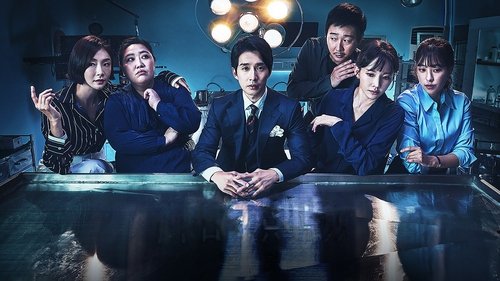




God’s Quiz leaned more toward mystery and investigation than medical themes. The main character, a medical examiner, spent more time working as a field detective and tracking down suspects than actual detectives did. I didn't appreciate how they established his character; he was portrayed as exceptionally intelligent due to a childhood drug experiment, which led to contrived scenarios arising from this condition throughout the series’ run. Each season altered this aspect in different ways, preventing him from developing into a consistent personality. This is a common issue with any unplanned subsequent seasons of a show, placing an almost impossible burden on writers attempting to maintain continuity across multiple installments. The production quality of Seasons 1 through 4 followed the same underwhelming template characteristic of OCN’s earlier work. The soundtracks in Seasons 1 and 2 were generic background music; Season 3 began incorporating actual music, though it suffered from noticeably poorer audio production overall. Season 4 showed a clear improvement in production values but still fell short of expectations when compared to other shows released around the early 2010s. However, Season 5 brought about proper production and other enhancements. The interactions between characters in Season 1 were awkward; everyone seemed to be overacting with forced and unnatural exchanges that simply didn't work. Season 2 showed some improvement, as the actors appeared more relaxed, but it still wasn’t quite right. The concluding scene of Season 2, featuring a kiss between two characters, was so visibly uncomfortable—the character’s lips were shaking noticeably—that it seemed they couldn't afford another take. Season 3 regressed with its recast, and Detective Bae Tae Shik introduced an unpleasant dynamic to the group; he didn't mesh well with the main lead, creating a poor on-screen pairing, which likely explains why the writer omitted him from later seasons, as did other characters associated with him. The attempted romantic relationship between two characters during Seasons 1 and 2 was painful to watch, but it improved considerably in Season 4 and was completely resolved in Season 5 by eliminating the immature romantic tension and allowing them to act like adults. I enjoyed seeing Kim Jae Won play a flamboyant villain in Season 5; it was entertaining to see him in a different kind of role. Each season followed a pattern: several cases were presented, leading into a final case spanning the last three episodes, which had some personal connection to the characters. These concluding cases in each season proved problematic for various reasons, with only Season 5 implementing them effectively despite having a weak climax. The cloning plotline in Season 4 felt cheap and poorly conceived, especially considering the potential for exploring it in much more interesting directions. Another awkward kiss appeared at the end of Season 4. The AI storyline in Season 5 felt contrived and difficult for viewers to accept. Overall, the cases were inconsistent across all seasons; some were decent and engaging while others were dull, flawed, or stretched too thin. Season 3 was particularly bad, featuring mostly poor cases alongside several other issues that made it the weakest season overall. The series as a whole had its good points and bad, built on an interesting concept with varying degrees of success. While Season 5 stands out as the best, it wouldn’t have been nearly as effective without the development of the characters' journeys throughout the earlier seasons. The final scene in Season 5, depicting both leads walking outside, was very well done. As a minor observation, it was hard to miss the main lead’s height.

On September 22, 2026
#5598▲ 1115
5598th by Pulse TV show online0.4PULSEPulse MeterOur daily Pulse Meter measures public activity and popularity signals across the web.How it works →