




Bill Nye the Science Guy — Season 4

Water possesses a vastness, and rivers a potent force. As they journey downhill, rivers erode rock and soil, sculpting canyons or carving sinuous curves into the landscape, features known as meanders. Occasionally, rivers swell and spill ov…
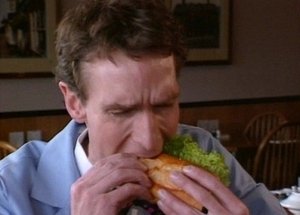
Every substance we consume as nourishment—proteins, fats, carbohydrates, vitamins, and minerals alike—is fundamentally composed of chemicals. Upon ingestion, the body reassembles these elements to generate energy. The quantity of energy der…
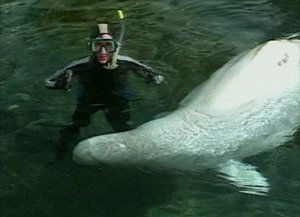
Whales, dolphins, otters, walruses, and orcas share a fundamental kinship with us: they are all mammals. Yet, their existence is defined by the ocean. Like us, they breathe air, possess hair, nurture their young with milk, and maintain a co…

Earthquakes occur when sections of the Earth's crust grind against one another. This crust is composed of vast slabs of land known as plates, which are in perpetual, subtle motion. These plates rub past each other, and occasionally their mo…

Bill Nye presents a countdown of the most memorable tracks from *Soundtracks of Science*. Interspersed with the music, Bill conducts fresh experiments on his lab bench. The lineup includes the grunge favorites Nyevana with their iconic "Air…

Often mistaken for insects, spiders belong to a distinct order of creatures called arachnids. A key difference lies in their anatomy: spiders possess eight legs, while insects have only six. Their bodies are divided into two segments – a ce…
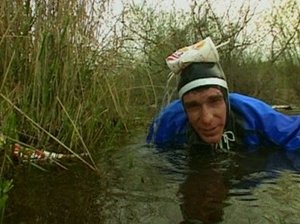
Pollution—in the form of contaminated water, soil, and air—is a consequence of human activity. We are the only creatures on Earth capable of generating such widespread uncleanliness. From discarded refuse and the combustion of fuels to indu…
Probability offers a method for gauging the likelihood of an event's occurrence. These measures are essentially predictions, often refined approximations. When a scientist seeks to determine a probability, they first assemble data and then …

For a long time, the world was believed to be flat, or nearly so. The notion of it being a vast sphere seemed outlandish. Yet, it is undeniably a sphere; proof exists. A fundamental principle of science is the testability of ideas. Scientis…
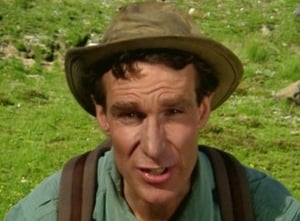
Flowers form a vital component of many plants, serving as the mechanism for propagation. These structures possess specialized elements known as stamens and pistils. When pollen from the stamen reaches the pistil, a process called pollinatio…
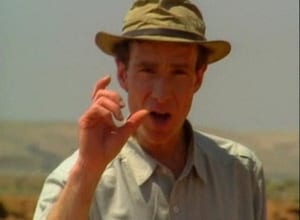
Archaeologists function much like detectives, employing scientific methods to uncover the details of life in bygone eras. They locate ancient cities, tombs, and temples through aerial photography, the study of historical documents, or by an…
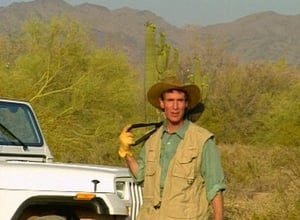
Deserts constitute roughly one-fifth of the Earth's surface. These arid regions are defined by their scarcity of precipitation, whether in the form of rain or snow, resulting in exceptionally dry conditions. Spanning vast expanses, deserts …
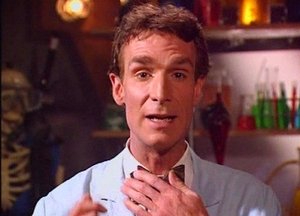
Amphibians—including frogs, toads, salamanders, newts, and the limbless caecilians—represent a fascinating group of creatures that bridge the divide between aquatic and terrestrial life. Characterized by their smooth, often moist skin, thes…
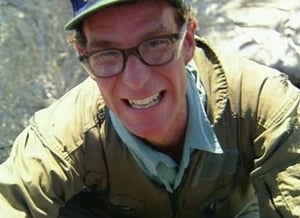
Volcanoes are mountains born of molten rock. The Earth's crust is structured as large, shifting plates, perpetually in slow motion. These plates rest upon the mantle, a layer of hot rock that flows with a viscous quality, like thick syrup. …

Worms, squid, clams, and flies belong to a group of creatures lacking a backbone – invertebrates. This absence of a spine defines a vast and diverse category of animals. Invertebrates populate every environment, from the ocean depths to fre…
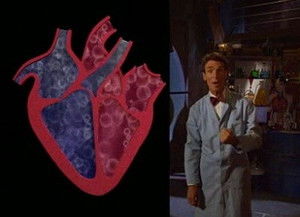
A constant, tireless rhythm sustains life: the heart’s ceaseless circulation of blood. Roughly the size of a fist, this vital organ is composed of a unique muscle known as cardiac muscle. This specialized muscle ensures a steady beat, c…

The world is filled with human ingenuity; from the simplest paper clip to the most complex computer, nearly everything we encounter has originated in the human mind, conceived, designed, and brought to life by human hands. An invention can …

Mick H. joins us today to explore a ubiquitous presence in modern life: the computer. These devices permeate our world, residing in automobiles, calculators, and televisions – indeed, you are using one now. Humans feed computers information…
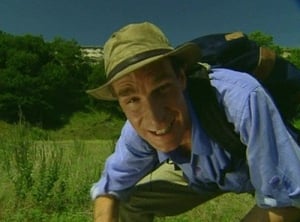
The majority of deceased creatures and vegetation eventually break down, returning to the earth as nutrients, yet some undergo a remarkable transformation into fossils. Fossilization begins when an organism dies and is subsequently buried. …
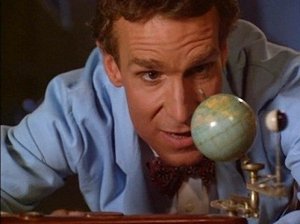
The passage of time shapes all living things. Trees relinquish their leaves, certain creatures awaken only under the cloak of night, and some insects appear with a cycle of seventeen years. Days, hours, minutes, and seconds—these are constr…














