




Bakuman — Season 1

Moritaka Mashiro, a student of unremarkable standing but possessing a keen talent for drawing, left his notebook behind at school. It was discovered by his classmate, Akito Takagi, who then perused its contents with interest. Admiring Mashi…

Over coffee, Takagi explained his choice of Mashiro. He’d found Mashiro possessed a quickness of mind that surpassed many of his classmates, a cleverness that extended beyond academic pursuits. He felt Azuki held a similar quality – an inna…

Mashiro and Takagi arrived at Mashiro’s uncle’s apartment, pausing to survey the space before Mashiro led Takagi through a collection of manuscripts and storyboards – the preliminary sketches a manga author crafts before commencing the fina…

Mashiro laid out his drawings for Takagi, patiently tracing over errors and explaining the nuances of manga-making tools. When Takagi inquired, Mashiro spoke of G-Pens and Kabura pens, of crafting manuscripts, and of Taro Kawaguchi’s tenets…

A shared glance between him and Azuki, a moment of mutual turning, always brought a smile to Mashiro’s face. He explained to Takagi that they had been attuned to each other for years, a silent understanding passing between them. Meanwhile, …

Mashiro and Takagi met with Akira Hattori, an editor at Shonen Jack. He observed that their work suffered from a tendency toward excessive text and a lack of visual dynamism characteristic of manga. Nevertheless, he recognized a spark of po…

Following their meeting with Hattori, Mashiro and Takagi returned to their work on new submissions. During class, Mashiro would jot notes to Azuki. A wave of tears overcame Azuki when Mashiro questioned whether their happiness was contingen…

Takagi offered further concepts, among them "One Hundred Millionth," a narrative exploring a society stratified by ability. Hattori was deeply impressed, prompting Mashiro to question the merit of his own work. The story was selected as a f…

Following an altercation with Ishizawa, resulting in a week-long suspension, Takagi’s situation weighed heavily on Mashiro. He sought out Takagi, discovering that the story concepts he’d shared were merely a fraction of his true ideas. It t…
Mashiro and Takagi met with Hattori, who informed them that while the manga artists had admired their work, the editors who would ultimately judge it considered it unlikely to be published. Eager for a quicker path forward, Mashiro mused ab…

While diligently working on their piece for *Money and Intelligence*, Mashiro and Takagi applied to North High School, a school known for its relaxed admissions. Miyoshi pondered the absence of interaction between Mashiro and Azuki, ultimat…

Following their celebratory dinner, Hattori, Takagi, and Mashiro drifted into a discussion about money and ambition, considering adjustments to their paths. Hattori suggested postponing serialization until after graduation, noting that even…

Following Miyoshi’s suggestion, Mashiro composed an email to Azuki, initiating contact. On their first day of high school, Mashiro and Takagi submitted their new pen name, "Muto Ashirogi." Hattori was clearly impressed with their offering, …

Mashiro has decided that pursuing mainstream battle manga is his path, diligently studying the character designs of established works to hone his craft. Meanwhile, Nizuma’s manga, “Yellow Hit,” is poised for serialization, but his editor di…

Hattori dissected the flaws in Mashiro and Takagi’s storyboard, explaining that a compelling narrative demanded well-developed characters, dynamic yet straightforward action sequences, endearing heroines, and a balance of tragedy and humor.…
Working with Hattori’s input, Mashiro and Takagi devised a story concept: angels battling other angels who prey on humans in a futile attempt at self-improvement. The proposed title was deemed unsuitable, though the feedback indicated poten…

Mashiro began his work as Nizuma’s assistant, quickly becoming acquainted with the other two. There was Shinta Fukuda, who had ranked below him in NEXT, and Takurō Nakai, a celebrated figure from a decade past whose subsequent efforts had f…

In revising Chapter 5, Fukuda confesses his discontent with several facets of Jack, most notably its popularity-driven series order. Yujiro, however, instructs him to secure serialization before offering critiques. Nizuma shares with Mashir…

Summer concluded without word from Takagi. He returned the key to Mashiro’s uncle’s apartment, offering a sincere apology for his delayed name, but declaring his intention to pursue a career as a manga writer. Mashiro then met with Hattori…

Mashiro and Takagi conferred on refining the core idea of their story, now titled *Detective Trap*. Takagi began poring over the collection of detective fiction Hattori had sent him. They then met with Hattori, firmly stating their intentio…

Mashiro and Takagi maintain their bi-weekly submissions, with Mashiro often sacrificing sleep to meet the deadline. Several weeks remain before the competition concludes. They encounter Nakai in conversation with Ko Aoki, the runner-up from…

Team Fukuda arrived at the editorial offices, but their objections fell on deaf ears. The editors remained unconvinced that Koogy’s advantage was illegitimate or his methods unethical, and Mashiro resolved to overcome him by crafting a supe…

Mashiro and Takagi both resolved to revise their manga. Fukuda, Aoki, and Nakai made the same decision. Subsequently, Fukuda’s work was presented first, garnering favorable reviews. Following this, Mashiro and Takagi’s manga also received p…
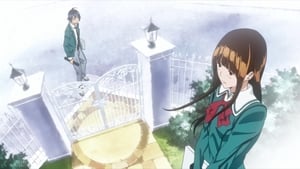
Koogy's manga performed disappointingly in the Golden Future Cup, leaving Mashiro, Takagi, Fukuda, Nakai, Aoki, and Ashirogi Muto as the leading competitors. In an unprecedented turn of events, a tie for first place occurred between Fukuda …

Thirteen series are presented for consideration during the serialization meeting, and the team captains, editor-in-chief, and deputy editor deliberate over them. From this group, *Detective Trap* and *Otter 11*, a manga by the promising new…