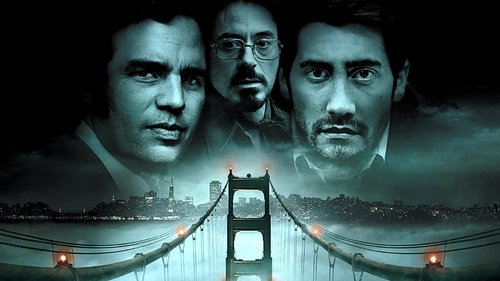



It strikes me that two years prior to Zodiac, Capote showed Truman Capote worrying about potentially lacking an ending for his important nonfiction book In Cold Blood. Robert Graysmith, the author of the factual works that inspired Zodiac, didn’t experience that problem, nor did director David Fincher. Perhaps it's not a fair comparison; Graysmith isn't like Capote (and honestly, who is?), and In Cold Blood isn’t structured as a mystery—even if you could technically classify Zodiac the same way, because after over two hours we aren’t really told who committed the crimes so much as which few people believe they know. Basically, this movie centers on an instinct. The film might be more effective (and I'm not saying it fails to work entirely) if it followed Capote’s example and focused on a person consumed by a crime and those responsible for it—particularly given that the Zodiac killings represent one of the most well-known unsolved murder cases in America; however, Fincher seems like what James Randi would describe as someone who truly believes, and Zodiac strongly suggests the director is just as certain Arthur Leigh Allen (played by John Carroll Lynch) was the Zodiac as he is that Herman Mankiewicz alone wrote the script for Citizen Kane. Zodiac does surpass Mank, though, because Fincher seemed more in control of his abilities in 2007 than he did in 2020; therefore, the earlier film presents a clearer and more persuasive argument for its central idea compared to the later one (and even this can be credited to the impressive supporting cast alongside the solid group of lead actors who also function as character players), although it ultimately remains a ‘what if?’ situation. The entire narrative is so fragile that it concludes—or rather stops abruptly, without a satisfying resolution—with a flawed statement: “Just because you can’t prove something doesn't mean it isn't true.” It would be more comforting if proof were possible, though.
On September 24, 2026
#224▼ 57
224th by Pulse movie online57.2PULSEPulse MeterOur daily Pulse Meter measures public activity and popularity signals across the web.How it works →