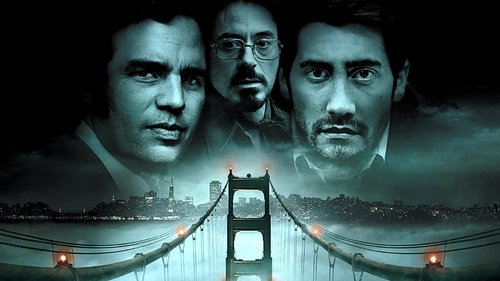





If you enjoy my Spoiler-Free reviews, please follow my blog @ https://www.msbreviews.com. I’ve been following David Fincher's work closely recently as I prepare for the release of his new film, *Mank*, which will premiere on Netflix in a couple of weeks. I’ve already rewatched *Se7en* and *Fight Club*, two films that had a significant impact on both filmmaking and our culture. However, *Zodiac* isn't one of Fincher's more popular movies, and that's possibly why I was watching it for the first time. Based on a true story, this is Fincher’s first adaptation of non-fiction material and also one of his longest films. I didn’t know anything about the actual events beforehand, which led me to what I consider to be the greatest compliment you can give a film based on real life. There are countless aspects that viewers can observe and analyze in a movie, ultimately forming an opinion. But when it comes to adaptations of true stories, there's one thing above all else that I value: how much the film inspires me to learn more about the story after watching it. The truth is, around halfway through *Zodiac*, I started to notice its length. Don’t misunderstand; it isn’t what people would describe as a “slow movie.” Quite the opposite, in fact. It's long, yes, but it’s filled with rapid-fire dialogue that Fincher himself asked the actors to deliver more quickly so that the runtime wouldn’t be even longer. Throughout the film, I felt exactly what the main characters were experiencing. For about an hour, the investigation was intensifying; murders increased, new developments emerged alongside suspects, letters, and ciphers—everything associated with a serial killer case. During this time, I felt completely engaged, but then came a point where the characters began to feel defeated due to the lack of solid evidence to convict anyone. I felt their frustration, depression, and even the infuriating absence of a clear path to finding the killer. However, Robert Graysmith's (Jake Gyllenhaal) obsession with the case eventually became my own, and the final thirty minutes were incredibly tense, frightening, and exciting. *Zodiac* runs for 157 minutes, mostly consisting of dialogue with only a few stylish, slow-motion murder scenes; it’s clearly a narrative driven by conversations. James Vanderbilt's screenplay is full of detailed character development, extensive discussions, and, from what I could tell, impressive historical accuracy. Fincher and Vanderbilt demonstrated their commitment through an incredibly thorough preparation process that essentially involved conducting their own investigation into the real case—interviewing people who were portrayed in the film, family members, police departments, witnesses, etc. This is further evidence of how important pre-production is to filmmaking. To put it simply, *Zodiac* achieved its primary goal. As soon as the credits rolled, I found myself searching online for information about the real case, eager to learn more about this fascinating story. It doesn’t even matter whether someone enjoys the film or not; its impact is undeniable because most viewers will feel compelled to understand more about what really happened. Two other elements significantly contributed to this result: the cast and the editing. The latter was handled by Angus Wall, whose work represents some of the finest film editing I've ever seen. It’s the main reason why the lengthy runtime feels appropriate and why the story moves so well. No wonder almost every one of his projects has received numerous award nominations. The actors are all excellent; Mark Ruffalo (Dave Toschi), Anthony Edwards (Bill Armstrong), Robert Downey Jr. (Paul Avery), and Jake Gyllenhaal deliver distinct, well-developed performances. Obsession is the central theme explored in the film, portrayed differently by each character. Armstrong completely moves on and leaves it behind. Toschi tries to forget, but he can’t accept that he failed. Avery develops a mental condition or addiction because of his inability to cope with the pressure, stress, and frustration of reporting the case. Graysmith allows his fixation on Zodiac to affect his personal life and impact his family. Fincher is able to portray these behaviors in an incredibly realistic way. The use of long, uninterrupted scenes helps the conversations flow more naturally, and Harry Savides’ simple, unobtrusive camera work keeps the focus where it belongs: on who's speaking. It's one of those films that I can’t really find any direct flaws with. There is a period during the second act when I began to feel tired and worn out, and despite the filmmakers' dedication to providing every single detail about the actual events, it’s still a large amount of information to process, which occasionally left me feeling lost. Fortunately, the movie ends strongly, concluding with a simple yet powerful exchange of glances. Overall, *Zodiac* earns the highest praise that a film based on a true story can receive from me. James Vanderbilt's screenplay inspired me to research everything about the real events as soon as the credits rolled, which is an undeniably impactful effect of watching such a well-written, captivating narrative with authentic characters. David Fincher’s commitment to historical accuracy is evident on screen—a remarkable result of extensive preparation that few filmmakers would even consider undertaking. With some of the best editing in cinematic history, the lengthy runtime feels more manageable than expected, but the sheer volume of information can be overwhelming and tiring, which temporarily lowers the entertainment level, especially during a certain section of the second act. Nevertheless, a phenomenal third act, three outstanding performances from Mark Ruffalo, Robert Downey Jr., and Jake Gyllenhaal, and an emotionally compelling, realistic approach to extreme obsession combine to make this one of the best films in its genre. Another strong recommendation. Rating: A-
On September 25, 2026
#2552▼ 1669
2552nd by Pulse movie online48.2PULSEPulse MeterOur daily Pulse Meter measures public activity and popularity signals across the web.How it works →














