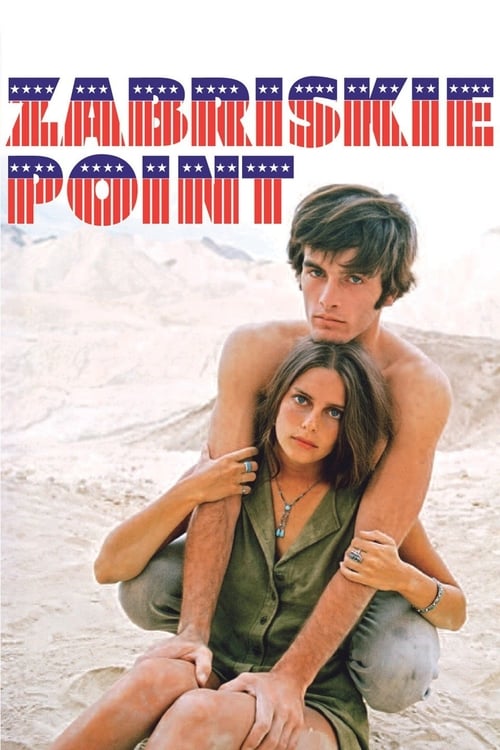





During the 1960s, director Michaelangelo Antonioni began making films outside of Italy. BLOW-UP, made in 1966, captured Swinging London at the beginning of the Sixties counterculture, where new trends in fashion and music were central to youth innovation. When Antonioni moved to the United States and started filming ZABRISKIE POINT, which was released in February 1970, he portrayed a more hardened and politically radical counterculture, with Black liberation movements and student protests advocating for aggressive or even violent methods of social change. In southern California, Mark (Mark Frechette) runs from a university protest after shooting at a police officer. Daria (Daria Halprin), who works as a secretary for a real estate developer building in the desert, is driving to Phoenix for a meeting. They meet when Mark, who has some pilot training, steals an airplane for a quick flight and playfully buzzes her car. After he lands, Daria quickly gets over her initial fear and becomes attracted to him. They spend an afternoon together at Zabriskie Point in Death Valley. However, they must eventually return to civilization, where tensions escalate. ZABRISKIE POINT was not well-received by critics when it first came out, so I anticipated disliking it. Despite the film's shortcomings, its flaws are minor and outweighed by everything else it offers. One issue is the acting during the brief scenes featuring the two main characters. Frechette and Halprin look great – they seem like established Hollywood stars rather than amateurs with counterculture backgrounds. However, while they’re visually appealing when alone, their interactions lack chemistry, and the dialogue feels awkward. Another problem lies in Mark's characterization: by the film’s end, Daria has witnessed events that make her angry and question the conventional society she works within. The script (written by Antonioni, Tonino Guerra, and Sam Shepherd) doesn’t explain why Mark is so driven toward destruction. As a result, viewers may see him as simply a troubled delinquent, making it hard to feel sympathy for his actions. Despite these weaknesses, the film proved enjoyable. Ignore the awkwardness between Mark and Daria; instead, appreciate Antonioni's visual style captured by cinematographer Alfio Contini. The Italians must have been impressed by what they found in America. California of that time is shown with its unique beauty, both the sprawling urban landscape of Los Angeles (already unfriendly to pedestrians) and the harsh but striking desert scenery. Antonioni’s characteristic filmmaking techniques from his Italian films are present here. Unexpectedly, the film concludes with a powerful scene – sometimes called "the violent scene" – which delivers a strong critique of complacent middle-class culture. It's possible Antonioni was inspired by Jean-Luc Godard's 2 OU 3 CHOSES QUE JE SAIS D'ELLE and wanted to create something even more impactful, resulting in a visually striking experience. It’s interesting how time can give a film new meaning beyond what the filmmaker originally intended. Antonioni shot this film in 1968-69 when the counterculture seemed full of possibilities, but today’s audiences will see it as a vivid record of a period that is now more than fifty years past, and the realization that all that vibrancy, idealism, fashion, and design has disappeared can be unsettling. While L'AVVENTURA, LA NOTTE, and L'ECCLISE are perhaps the best way to become familiar with Antonioni’s work, I am glad I explored his other films. Although ZABRISKIE POINT is noticeably flawed compared to those earlier works, it has lingered in my thoughts for weeks after watching it, which says a lot about its merit.
On September 28, 2026
#8818▼ 869
8818th by Pulse movie online37.1PULSEPulse MeterOur daily Pulse Meter measures public activity and popularity signals across the web.How it works →














