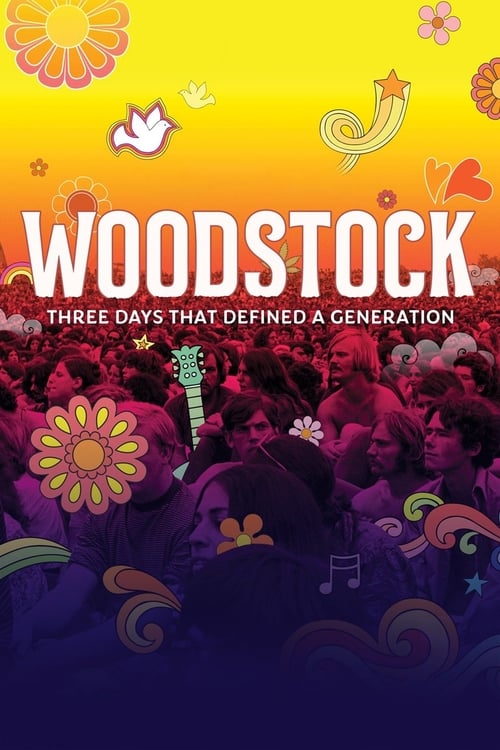





Released fifty years after the actual event, “Woodstock: Three Days that Defined a Generation” looks back at the iconic concert held over 3.5 days in mid-August of 1969. This occurred during a time of war and social change. Early estimates suggested an attendance of around 50,000 people, but later guesses put the number closer to 150,000. Ultimately, far more individuals showed up than anticipated—over 400,000—making it the largest gathering in history at that point, only surpassed by a concert held on the Isle of Wight in England a year afterward. The film portrays both the positive and negative aspects of hippie culture, leaning mostly toward the former. Generally speaking, this movement was a reaction to the Vietnam War and what some perceived as an overly rigid legal system in America and similar countries. The youth were seeking freedom, peace, and love—and that’s evident throughout the movie. It was a positive thing, although you could also see the downsides, like experiences with psychedelic drugs. Janis Joplin and Jimi Hendrix both performed at Woodstock, but tragically passed away less than a year later, both dying at age 27. Jim Morrison & The Doors didn't participate because they declined at the last minute, a decision they later regretted; he too died shortly after the others, also at 27. Interestingly, Jethro Tull was unable to perform because Ian Anderson felt uncomfortable with hippies and worried about things like public nudity. Woodstock remains an unforgettable event that will likely never be replicated. Attempts were made afterward at Altamont Speedway in California and on the Isle of Wight, but both festivals ended poorly and seemed to extinguish the movement’s idealistic principles, although such a downfall was probably inevitable given how freedom without boundaries can easily lead to chaos and self-destruction. Like the original 1970 documentary, this new version is captivating and highly enjoyable, though it doesn't focus as much on the music itself. There are snippets of songs, but never complete recordings. This edition includes more behind-the-scenes material, detailing how four individuals—Michael Lang, Artie Kornfeld, Joel Rosenman, and John P. Roberts—conceived of the event; the last two provided financial backing. The initial planned location was Wallkill, New York. Just five weeks before the concert, local officials put a stop to it after considerable progress had been made on building the grounds. Fortunately, Max Yasgur offered his dairy farm in Bethel as an alternative, which is located about 40 miles west of Wallkill. A significant part of what makes both documentaries so appealing is the sheer scale of the event and the entertaining mishaps that occurred. This includes footage of the people who attended: the hippies, the organizers, the workers, the performers, and the adults who were there trying to help or simply make the best of things. Skinny dipping, for example, was a notable occurrence. While it seemed like an interesting experiment at the time, it never really became part of mainstream culture—likely because few people want to see someone else’s private parts; and unless a woman has a model's figure, who would want to? But what can explain Woodstock’s widespread popularity? What motivated so many hippies to attend? It wasn't just the music. In the 1970 film, a young man appearing to be around 16 or 17 said that for him it was more than just the tunes. He and his fellow hippies seemed to emerge from nowhere, like zombies searching for comfort, a sense of community, and a reason to… live… and celebrate—and Woodstock fulfilled that need. It’s striking how diverse the musical styles were and how relatively gentle they were. Many performances were energetic, but they lacked the intensity that rock and metal would later develop in the 1970s and beyond. There was acoustic folk music, Caribbean sounds, blues, rock, gospel, pop, music from the 50s, Latin rock, jazz fusion, and psychedelic rock. What’s remarkable is how brief the classic hippie era really was. It began around 1965, with Woodstock marking its peak in August 1969—just four years later. From there things went downhill, with Altamont, the Isle of Wight concert, and the deaths of many prominent figures from the movement, not to mention the Manson murders a week before Woodstock. Thankfully, we have both the original documentary and this new one to see the positive aspects of that time—some bad, some silly, but mostly good, and all entertaining. There was no violence reported. Two births were recorded alongside two deaths: one from a drug overdose and another involving a man who was accidentally run over by a tractor while sleeping underneath it (the driver wasn’t aware he was there). The film was primarily shot in Bethel, New York, and runs for 1 hour and 46 minutes. GRADE: A
Woodstock: Three Days That Defined a Generation (2019)
2019 • 1h 46m • Documentary, Music • Not Rated
On October 3, 2026
#22701
22701st by Pulse movie online2.4PULSEPulse MeterOur daily Pulse Meter measures public activity and popularity signals across the web.How it works →