




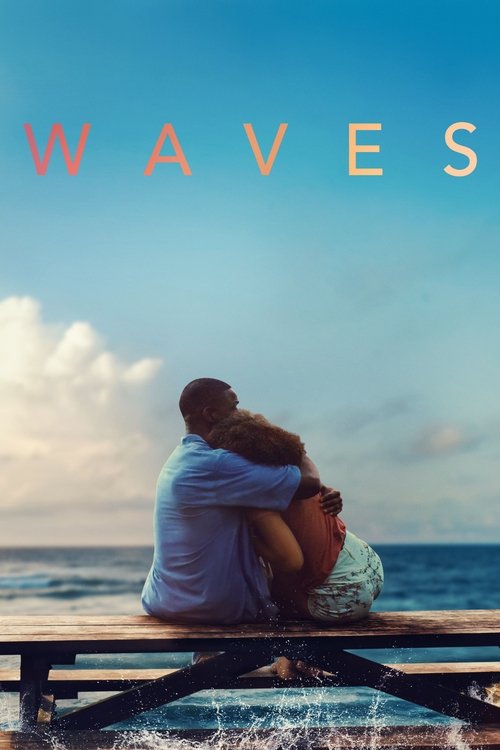
**_Bleak, but not despondent; brilliant, but not for everyone_** It's common to describe films as "challenging," and that certainly applies to writer/director Trey Edward Shults’s previous works, _Krisha_ (2015) and _It Comes at Night_ (2017). While these earlier movies seem different from the more realistic story of _Waves_, they all explore families facing intense struggles. And yes, like his prior films, _Waves_ is challenging in its own way. The film also carries the label "not for everyone," which rings true here as it did with Shults’s previous projects. Those who appreciate stylistic filmmaking will find a lot to enjoy: elaborate camera movements, different aspect ratios, striking color correction, unique shot composition, and an immersive sound design that blends into the music – all of these elements are present. However, _Waves_ is emotionally difficult and takes its time unfolding. It demands more from viewers than your typical blockbuster, and some may simply not want to invest the effort. If you consider cinema primarily as entertainment, you might find _Waves_ boring or frustrating. But if you’re willing to engage with the film's journey, the emotional rewards are significant. The story unfolds in a Florida suburb, where Tyler Williams (Kelvin Harrison Jr.) is a popular high school senior and talented wrestler deeply in love with Alexis Lopez (Alexa Demie). He has a good relationship with his sister Emily (Taylor Russell) and stepmother Catherine (Renée Elise Goldsberry), but his connection with his father Ronald (Sterling K. Brown) is strained because Ronald, a former athlete whose career was cut short by an injury, constantly pushes him toward success. As the film begins, Tyler’s shoulder is causing problems; he learns that he needs surgery and time off from wrestling to avoid permanent damage. Ignoring medical advice, Tyler continues to wrestle and starts using painkillers. His attitude worsens as he grapples with Alexis's pregnancy. Around halfway through, the narrative shifts its focus to Emily, who is shy and socially awkward, and her developing romance with Tyler’s wrestling teammate Luke (Lucas Hedges). Simultaneously, the Williams family confronts a devastating event that could change their lives forever. A striking aspect of _Waves_ is its visual boldness. Shults drew inspiration from Wong Kar-wai's _Chungking Express_ (1994) when deciding to divide the story in two parts. What’s particularly interesting about this structure is that Emily barely appears in the first half, and Tyler is largely absent from the second, forcing the audience to completely reorient themselves. However, the film’s visuals truly stand out. Shults and his cinematographer Drew Daniels use inventive techniques that always serve the story; the camera work isn't just for show. For example, the opening shot places the camera between Tyler and Alexis in a car, spinning in circles rather than cutting to create multiple 360-degree rotations. This immediately establishes their sense of excitement and love. Before any dialogue is spoken, Shults reveals who these characters are through visuals. This connection between form and content continues throughout the film. The restless, fast-paced energy of Tyler is reflected in a handheld camera that rarely stops moving during his section, while Emily’s quieter nature is mirrored by more static shots and slower editing when the narrative shifts to her. The color palette also changes to reflect this shift – the first half uses vibrant blues, reds, and greens, while the second has a more natural look. The film's visual identity is further defined by its unusual use of aspect ratios. Starting with 1.85:1, the frame gradually narrows to Academy ratio (1.33:1) at the end of Tyler’s section, then widens again to 2.35:1 as Emily’s story unfolds. The narrowing ratio in the first half symbolizes
On September 20, 2026
#4155▼ 390
4155th by attention movie online47.9Attention ScoreAttention ScoreOur daily Attention Score measures public activity and popularity signals across the web.How it works →