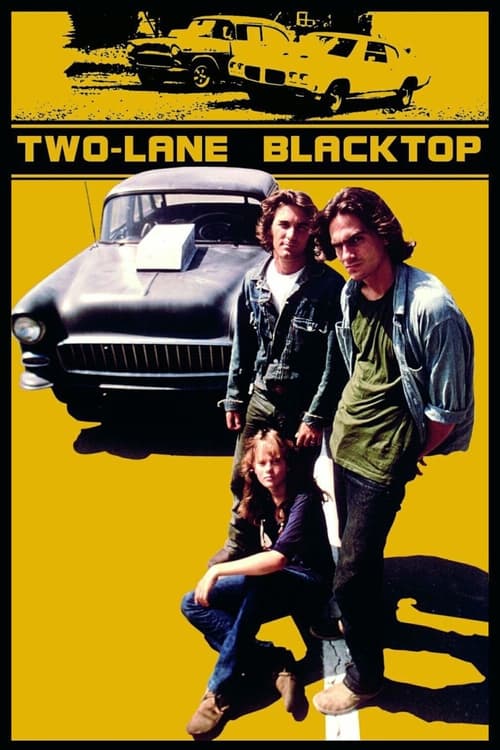




“Two-Lane Blacktop” (1971) follows a driver and mechanic—played by James Taylor and Dennis Wilson respectively—as they journey across the American landscape in a customized 1955 Chevy. Along the way, they encounter a young woman seeking casual relationships (Laurie Bird), and become involved in an aimless competition with another man driving a GTO from an earlier generation (Warren Oates). Esquire magazine promoted the film before its release as the next significant counterculture movie, comparable to “Easy Rider” (1969). However, it failed to find success at the box office because it’s more of a meandering journey featuring characters who are essentially one-dimensional and uninteresting. As my title suggests, this is an existential film with occasional awkward dialogue rather than standard entertainment, which explains why many viewers consider it dull and disappointing. The narrative and underlying ideas aren't as captivating as those in films like “Bonnie and Clyde” (1967) or “Easy Rider,” nor are they as entertaining as the later “Dirty Mary Crazy Larry” (1974), which explored similar themes with greater success. A comparable film, "Vanishing Point," arrived in theaters four months prior and proved to be more memorable. Despite its lack of mainstream appeal, “Blacktop” has gained a cult following due to certain strengths, notably the presence of two well-known musicians. Wilson delivers a stronger performance than Taylor, though neither actor reaches the level of Adam Roarke and Peter Fonda in "Dirty Mary Crazy Larry." Bird's contribution is also less impactful than Susan George’s. Still, they are adequate for this unusual film, and it represents the only substantial acting roles these performers had at their peak. Dennis Wilson never acted again after this failure, and James Taylor stayed away from performing for over a decade, eventually returning to television in minor roles. Laurie Bird appeared in just two other small films before tragically taking her own life in Art Garfunkel’s Manhattan penthouse in 1979. The film's true value lies in its underlying themes. It suggests that while America can be beautiful, it is more often a desolate place filled with struggling and alienated people who have lost their sense of direction. In the aftermath of the 1960s, car enthusiasts take on the role of gunslingers from the Old West, competing to demonstrate their speed. Simultaneously, local residents view outsiders with suspicion in the wake of the Manson Family murders, even though these characters are not stereotypical drug-addled hippies. The supposed “race” never truly happens because one participant didn’t put up the promised pink slip as collateral. This results in a pointless trip without a clear destination. The protagonists' limited communication—restricted to discussions about their car—is briefly disrupted by the young woman, who quickly grows bored and leaves to pursue other options. Her rendition of “(I Can’t Get No) Satisfaction” at a restaurant serves as an illustration of this. Ultimately, “Blacktop” is far from a fun or exciting road movie. It's a somber reflection on American society shortly after the rebellious 1960s and during the waning years of the Vietnam War. The film’s running time is 1 hour and 42 minutes, and filming locations included Needles, California; Arizona; New Mexico; Oklahoma; Tennessee; and North Carolina—in that order. GRADE: B-
On September 27, 2026
#11317▼ 6571
11317th by Pulse movie online33.5PULSEPulse MeterOur daily Pulse Meter measures public activity and popularity signals across the web.How it works →














