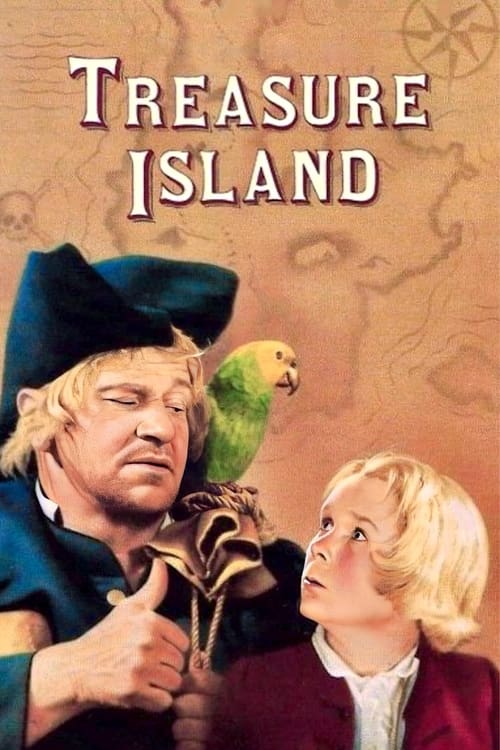




I was fortunate in high school; my English teachers chose well. While some of my classmates were reading books like “The Great Gatsby,” “The Pigman,” and “Hamlet,” I was studying "Frankenstein," "In Cold Blood," and "Macbeth." Another classic I avoided then, "Treasure Island," I now understand might have been better left unexamined after seeing the 1934 film. Jim Hawkins (Jackie Cooper) and his mother (Dorothy Peterson) operate a small inn in England. One night, a nervous drunk named Billy Bones (Lionel Barrymore) arrives, warning Jim to be wary of a one-legged man searching for Billy and the secret contained within his ship's chest. True to form, Billy draws attention to himself and dies after drinking heavily, just as mysterious men appear at the inn seeking Billy’s secret—a treasure map. Jim takes possession of the map, shows it to the local magistrate/doctor Livesey (Otto Kruger), and the local squire Trelawney (Nigel Bruce) finances an expedition to the Caribbean to find Billy Bones' treasure. The ship, the Hispaniola, is under the command of Captain Smollett (Lewis Stone), but crew members keep disappearing before departure. Long John Silver (Wallace Beery), a one-legged tavern owner, is hired as cook and brings along his own associates to fill out the crew. Of course, Silver is the man with the missing leg that Bones warned Jim about. He befriends the boy while gathering information about the location of Bones’ treasure. Silver's men begin killing off the original crew, and after Jim alerts the captain and others to Silver's plan, a frantic search for the treasure ensues once the ship reaches the island. I have heard that Beery and Cooper previously worked together more successfully in "The Champ" a few years earlier. In that film, Cooper’s crying reportedly moved audiences to tears, and from what I’ve seen, it's easy to understand why—he was very good then, not overly cute, and believable. Here, as Jim, he cries again when Silver acts cruelly, but the effect isn’t quite the same. As Silver repeatedly manipulates Jim and is confronted about it, Jim weeps, only to immediately trust him again. It gets to the point where Jim's innocence seems like irritating naivete, because he doesn't appear to learn anything—from the beginning of the film until a peculiar final scene. And what Jim witnesses! Director Fleming, known for "The Wizard of Oz" and “Gone With the Wind” (where he took over from another director in both cases), is more an action filmmaker. "Treasure Island" contains violence even by 1930s standards; one man is crushed by a wagon, and his screams are visible. Murders happen around Jim at a startling rate. He’s threatened, grabbed, and even forced to kill. Yet, he continues to see the good in Silver, while Fleming fills the screen with bloody chaos—accompanied by cheerful sea shanties and comic relief from Charles "Chic" Sale as Ben Gunn, a man who has lived on the island for three years without human contact. The tone is so jarring and strange that I watched simply to see what horrors Jim would experience next, and suppress. Someone ought to write a sequel where Jim ends up in an asylum like Bedlam, a trembling wreck expecting drunkards and one-legged men to suddenly appear and attack him. Beery and Cooper don't even attempt English accents, and while the film is well-shot, it feels theatrical. The scenes aboard the ship work reasonably well, and some of the supporting performances are strong—Barrymore’s in particular—but you can often see Beery’s leg awkwardly bent to simulate its absence due to poor editing. While this version of "Treasure Island" isn't entirely bad, coming from the Golden Age of Cinema in the 1930s, it is disappointing. I will revisit “Mutiny on the Bounty” and “Captains Courageous” next time I’m in the mood for big boats and open water.
On September 27, 2026
#18665▼ 7514
18665th by Pulse movie online25.0PULSEPulse MeterOur daily Pulse Meter measures public activity and popularity signals across the web.How it works →