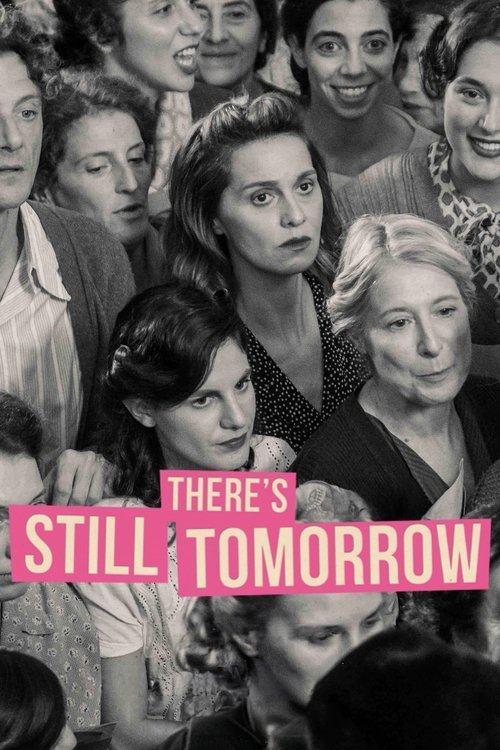




It can be genuinely difficult to present a serious message using humor, and when the attempt falls short, the intended meaning risks getting lost or muddied. That’s what happens, regrettably, in actor-director Paola Cortellesi's first feature film about women’s empowerment following World War II; it’s a somewhat perplexing release that doesn’t quite succeed in blending humor and drama while exploring its themes. The story unfolds in Rome during 1946, shortly after women gained the right to vote, centering on Delia Santucci (Cortellesi), a working-class mother of three whose life is largely bleak as she struggles with a marriage to an overly suspicious and controlling husband, Ivano (Valerio Mastandrea), who resorts to physical and verbal abuse. She desires a better existence for herself, and several people encourage her pursuit of it, including an old flame (Vinicio Marchioni), a kind American MP (Yonv Joseph), two sympathetic neighbors (Emanuela Fanelli, Raffaele Vannoli), her daughter Marcella (Romana Maggiora Vergano), who is about to become engaged, and even her live-in father-in-law (Giorgio Colangeli), who’s often grumpy but not entirely unsympathetic. Despite her efforts, Delia's progress is frequently hampered by circumstances and her own hesitation to make a change. When the chance arises for a fresh start, will she be able to meet the challenge? The premise seems promising, but the execution feels inconsistent. A good portion of the film incorporates gentle humor that’s often skillfully delivered, generating laughs reminiscent of the Oscar-winning “Moonstruck” (1987). However, this comedic element frequently clashes with the more serious aspects of the story, such as domestic violence, limitations on self-expression, and equal pay and job opportunities. The theme of women's suffrage also plays a significant role but is largely treated as an afterthought throughout much of the film. Furthermore, the musical choices are baffling, like the odd inclusion of modern songs in the soundtrack for a period piece set in the 1940s, and fantasy song-and-dance sequences intended to illustrate the ambiguity often present in situations involving spousal abuse—a treatment that arguably trivializes the issue. The film’s black-and-white cinematography is frequently beautiful, and the performances from the strong ensemble cast are truly noteworthy. “There’s Still Tomorrow” was a significant box office success in Italy and won six David di Donatello Awards, which are Italy's equivalent of the Oscars (though these accomplishments seem surprising). Overall, the combination doesn't quite work given the subject matter and apparent goals of this project. Perhaps this is attributable to Cortellesi’s debut as a director, or maybe it reflects a prioritization of style over substance. Regardless, the film appears to represent a lost chance to make an important statement—one that many Italian women still grapple with even now.
On October 1, 2026
#21078
21078th by Pulse movie online2.5PULSEPulse MeterOur daily Pulse Meter measures public activity and popularity signals across the web.How it works →