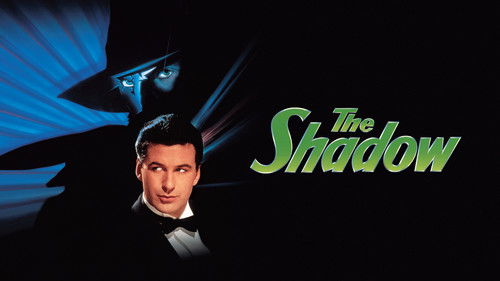




The story finds Lamont Cranston (played by Alec Baldwin) battling corruption within New York City during 1930 and 1931, following a spiritual awakening and training he received in Tibet earlier in the 1920s. When a descendant of Genghis Khan arrives with nefarious intentions, Cranston, as the enigmatic Shadow, begins working to thwart his schemes. The cast includes Penelope Ann Miller as a socialite, Ian McKellen portraying her father, Tim Curry in a quirky role, Peter Boyle as the Shadow’s taxi driver companion, and Jonathan Winters taking on the part of the police commissioner. "The Shadow," released in 1994, is an acceptable adaptation of the radio, pulp magazine, and comic book character who first appeared in 1930. It's noticeable that the film drew inspiration from "Batman" (1989), a curious connection considering The Shadow was actually one of the influences behind Batman’s creation nearly nine years later, in 1939. Those who enjoy the “Batman” films, “Dick Tracy” (1990), and “The Rocketeer” (1991) will likely find something to appreciate here. What stands out most, apart from the impressive recreation of New York City around 1930, is Alec Baldwin’s performance as the shadowy crime-fighter and the authentic visual representation of The Shadow himself. Baldwin was in excellent shape at that time and possesses a certain intensity that suits Lamont Cranston's character. And the design of the Shadow’s appearance—including his prosthetic nose—is spot on. While I did enjoy the film, it would have been improved if they had eliminated some of the more outlandish elements (like Tim Curry’s performance) and aimed for a tone closer to the later "Batman Begins" (2005), which itself was influenced by this movie. The film does maintain a serious and dark atmosphere overall, but there are moments that feel like typical comic book silliness. Because Cranston/the Shadow is easily the most compelling character, more attention should have been given to his story arc. Instead, we’re presented with an over-the-top villain when a more ordinary adversary—similar to Marvel's Kingpin—would have served the plot better. The movie has a running time of 1 hour and 47 minutes and was filmed primarily on Universal Studios’ backlot in Hollywood, utilizing five sound stages, along with a brief five-day shoot at locations including the Ambassador Hotel & Pantages Theatre in Los Angeles, Mayfield Senior School in Pasadena, and Alabama Hills in Lone Pine, California. GRADE: B-
On September 23, 2026
#5502▲ 139
5502nd by Pulse movie online45.2PULSEPulse MeterOur daily Pulse Meter measures public activity and popularity signals across the web.How it works →