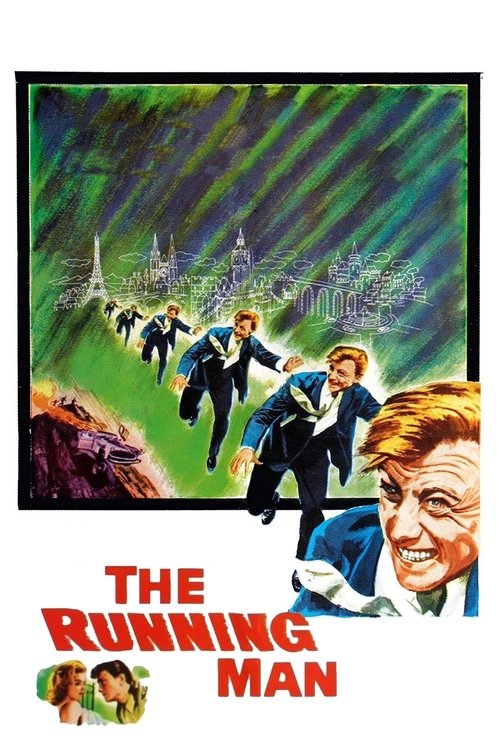




Many are familiar with The Running Man as a somewhat lackluster Arnold Schwarzenegger action movie from 1987, but there's an earlier version, released in 1963 and starring Laurence Harvey, Lee Remick, and Alan Bates, that centers on a man whose life is upended by the allure of wealth. The story begins in London, where Stella (Remick), a grieving widow, puts on a public display of mourning for her husband, who supposedly died in a glider accident along the southern coast. However, he isn’t dead; the staged tragedy was part of an elaborate scheme to defraud an insurance company that had previously denied him a payout following a prior plane crash. The fact that his policy had lapsed and he wasn't insured at all seems irrelevant to Rex (Harvey), who appears to operate outside of conventional logic. Rex and Stella’s brief reunion in London is interrupted by Stephen (Bates), an insurance salesman with questions about the accident—specifically, the lack of a body. Fortunately for them, this policy was valid, so the company pays out, and Stella joins Rex in Spain. There, he has adopted a new identity as an Australian sheep farmer, flaunts his wealth in a large American car, and generally spends money without restraint. That’s not the end—it's merely the beginning. In Spain, the action truly escalates when the couple, now pretending to be strangers, unexpectedly encounter Stephen, who claims to be on vacation. A suspenseful thriller unfolds, complicated by Stephen’s attraction to Stella and Stella’s possible reciprocation, or perhaps her attempt to get her increasingly boorish husband's attention. The film was clearly intended as a big-budget production, evident from its James Bond-style title sequence by Maurice Binder to its vibrant, saturated color scheme reminiscent of Blake Edwards’ The Pink Panther (released the same year), and underscored by a noirish score composed by William Alwyn (his final work). Director Carol Reed reunited with his collaborator on The Third Man, cinematographer Robert Krasker, demonstrating their versatility—though the expressionistic camera angles characteristic of Reed's earlier films are notably absent. Instead, the initial premise of a man presumed dead who is actually alive echoes the themes found in The Third Man. Reed and Krasker capture the sun-drenched southern Spain during a period when tourism was just beginning to flourish—a landscape still populated by women in black dresses, donkeys, and children begging for pesetas. This setting worked effectively in post-war Vienna in The Third Man, adding an element of desperation to a story about struggling people. Here, however, the effect is less impactful; Reed incorporates so much of Spain – flamenco dancing, bullrings, etc. – that it leaves little room for building tension. Harvey delivers an interesting performance. Rex is an entitled and largely unsympathetic character from his first appearance, becoming increasingly self-absorbed as the film progresses, allowing wealth to corrupt him. Harvey had already starred in Room at the Top, Butterfield 8, and The Manchurian Candidate, but he may not have realized that his popularity was beginning to decline. Playing aloof and unlikeable characters might not be what audiences desire, though it’s undeniable that he portrays them well. Remick is a standout; she exudes youthfulness, grace, and subtlety before her later, more rigid screen presence. Bates plays his role with straightforwardness, conveying the sense that every word he speaks could be a lie. The underlying story is solid, and the situation—three individuals spiraling toward disaster by rigidly adhering to their fabricated narratives – provides the film's suspense and justifies the investment of time. It’s not bad at all, although a degree of nostalgia for films from that era certainly enhances the viewing experience.
On September 28, 2026
#20519▼ 3131
20519th by Pulse movie online23.4PULSEPulse MeterOur daily Pulse Meter measures public activity and popularity signals across the web.How it works →