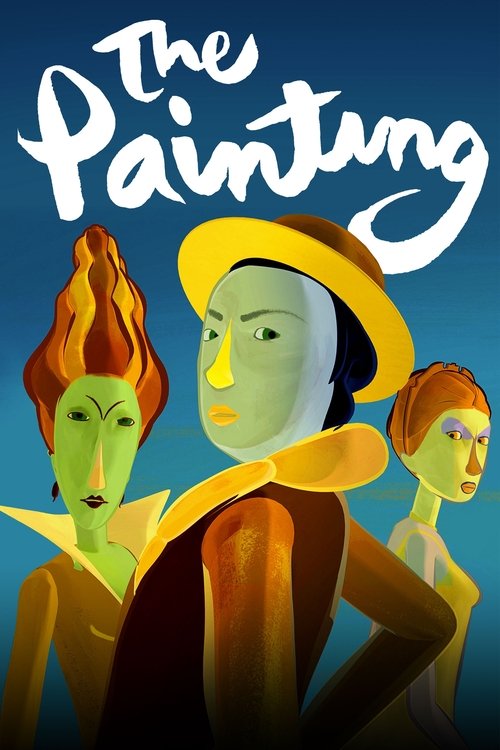




Le Tableau presents a clever combination of Romeo and Juliet and The Wizard of Oz. It’s also layered with meaning beneath its surface. Ramo (Adrien Larmande) and Claire (Chloé Berthier), star-crossed lovers, must keep their relationship hidden due to differences in social standing and religion. This storyline has been explored countless times before, but never quite like this animated film co-written and directed by Jean-François Laguionie. Ramo and Claire are characters within an unfinished painting; he’s one of the aristocratic Toupins (meaning ‘fully drawn’), who reside in the palace, while she belongs to the stigmatized Pafinis (‘not finished’), living in the garden. There's also a group called the Reufs, banished to the "Cursed Forest" with its "Flowers of Death." The Pafinis are waiting for the Painter’s return—essentially, his Second Coming—so he can complete them. The Toupins, influenced by the Great Chandelier (Jacques Roehrich), believe the Painter won't reappear because his work is already complete ("And if he made us, the Toupins, the only perfectly drawn beings in his works, it is because such was his intention"). As for the Reufs, "it is said that they believe in nothing." Surprisingly, the romantic plot is the weakest part of the story; Claire, with her elongated design reminiscent of Amedeo Modigliani, feels somewhat bland. Fortunately, Lola (Jessica Monceau), who possesses the confidence and features of a young Salma Hayek, emerges as the true heroine. She takes on the role of Dorothy alongside Ramo, Plume (Thierry Jahn)—a Reuf whose friend was transformed into abstract art by the Toupins—, Magenta (Thomas Sagols), a soldier from another painting, who together step out of their painted world to visit what seems like an abandoned studio belonging to the Painter. They learn quite a bit about him through his other works, including a self-portrait and a nude portrait of a former lover named Garance. Through this painting, they gain access to Venice—the Painter’s imagined Venice: an endless carnival masking deep sadness and loneliness. Eventually, the characters decide to take matters into their own hands; using the Painter's self-portrait and materials found in his studio, the ‘unfinished’ complete themselves. This is significant because it isn’t the Toupins who learn to accept the Pafinis as they are, but rather the Pafinis who adapt to fit in with the Toupins. However, Le Tableau focuses more on free will than tolerance (as the Painter tells Lola when she finally finds him: "I didn't abandon them; [on the contrary], I gave them the essentials"). Notably, Lola is the only Toupin who refuses to become a Toupin and the only one who rejects being contained within a frame. Le Tableau is an impressive combination of styles—3D digital animation designed to look hand-drawn, combined with live action and photorealistic CGI (arguably the best use of these technologies I've ever seen)—paying tribute to Chagall, Modigliani, Picasso, and Matisse. It’s primarily a collection of ideas; a meditation on art, reality, perception, identity, and the artist’s role as a creator.
On September 30, 2026
#80529▼ 13360
80529th by Pulse movie online0.2PULSEPulse MeterOur daily Pulse Meter measures public activity and popularity signals across the web.How it works →














