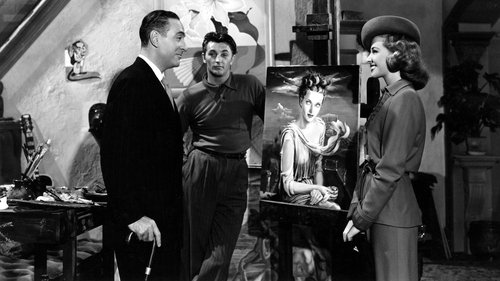




John Brahm’s The Locket (1946), or “What Nancy Wanted” Written by Wheeler Winston Dixon There are numerous complex noirs, but nothing quite prepares you for watching John Brahm’s The Locket (1946), which is known for its unusual “flashback within a flashback within a flashback” structure—perhaps the most intricate narrative in noir history. The basic story revolves around Nancy (Laraine Day), who compulsively steals items that catch her eye; the film was originally titled “What Nancy Wanted.” This compulsion stems from an event in her childhood, when she received a locket as a birthday gift, only to have it taken away by Mrs. Willis (Katherine Emery), her mother’s employer. When the locket disappears, Nancy is suspected of stealing it to retrieve it for herself. Although it's later revealed that the locket simply fell into the hem of a garment, Nancy isn’t fully cleared. Now, twenty years have passed, and she’s about to marry John Willis (Gene Raymond), which would allow her reentry into the household from which she was banished as a child; Mrs. Willis doesn't recognize Nancy, having only known her as a young girl (played by Sharyn Moffet). However, despite this seemingly straightforward setup, there are many complications. The film begins on Nancy’s wedding day. Just before the ceremony, psychiatrist Dr. Harry Blair (Brian Aherne) interrupts to speak with John. It turns out that Dr. Blair was previously married to Nancy; he warns Willis not to marry her because she is mentally unstable. As Blair recounts his marriage to Nancy in a voiceover flashback, he also tells the story of another of Nancy’s husbands, Norman Clyde (Robert Mitchum), an artist who ultimately committed suicide due to Nancy’s thefts and involvement in a murder. This all unfolds backward, returning to Nancy's childhood and the incident with the locket, before moving forward again to the present, where John Willis, having heard Blair’s account, confronts Nancy, who predictably denies everything. Only Nancy’s collapse at the altar, triggered by Mrs. Willis giving her back the locket she briefly possessed as a child, prevents John Willis from suffering a similar fate in marriage. As The Locket concludes, Nancy is sent to an asylum for treatment, but the camera lingers on the gloomy mansion belonging to the Willis family on Fifth Avenue. What has happened has affected not only Nancy but everyone who knew her, and even Dr. Blair’s skills as a psychiatrist prove useless until after the fact. For much of the film, Nancy's mental state goes unnoticed, and anyone who discovers her secret is destroyed. Therefore, nothing can be taken at face value, especially claims of innocence; appearances are deceptive. Director John Brahm maintains control throughout the film, staging most of it at night in claustrophobic studio sets. Mitchum, a rising star at that time, gives an unusual performance as Norman Clyde, a moody artist with a distinctive personality, and Nicholas Musuraca’s lighting creates a constant sense of confusion and suspense for both the characters and the viewer. The film's triple-flashback structure is particularly intriguing, raising questions about the reliability of its narrative. Within Blair’s flashback are Norman Clyde’s memories, which contain Nancy’s own recollections of her childhood—memories she told to Norman concerning the locket incident. Thus, we only have Nancy’s account, relayed through Norman and then through Dr. Blair, that any of this is true, yet we unquestioningly accept all three versions of events. Why? The story is so outlandish that one can understand John Willis's distrust of Blair's accusations; Nancy seems like a “nice girl.” The failed wedding at the film’s climax serves as proof enough of Nancy’s condition, but are all the details about her illness entirely accurate? We have only the accounts of three interwoven narratives to determine this, refusing to reveal their secrets until pressure is applied. The world depicted in The Locket is one of doom and betrayal. Relationships thought to be permanent fail. Friends don't believe you. Even the police are skeptical. You can’t even trust yourself; you become your own worst enemy. Helpless against forces beyond control, which have decided to deal you a much more unpleasant future, you simply must accept it and hope for the best. The world of The Locket represents domestic life in peril, collapsing outside the typical values of postwar society—values that are themselves constantly changing. While the family unit is often celebrated as the ideal social structure, can it truly be so when so much is at risk and remains unexplained? For Nancy in The Locket, the answer is a clear no. http://www.noiroftheweek.com/2009/04/locket-1946.html
On September 23, 2026
#24659▼ 3920
24659th by Pulse movie online20.3PULSEPulse MeterOur daily Pulse Meter measures public activity and popularity signals across the web.How it works →














