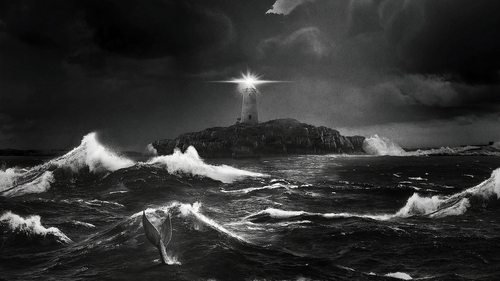





I’m drawn to unusual films—those moments of awkwardness, perplexing ambiguity, or just plain bizarre sequences that really grab my attention and make me wonder what the filmmaker is trying to convey. *The Lighthouse* certainly fits into that category; it's a psychological horror film that will leave you questioning what you've witnessed. Surprisingly, though, this one is quite accessible, with most of the story being fairly straightforward to understand. I really hope Robert Eggers’ movie gets a strong release on home video. It seems like audiences often dislike films that are open to interpretation. These days, people want everything handed to them before they even begin watching—think trailers. So, a film about two lighthouse keepers descending into madness, with scenes that initially seem nonsensical (but ultimately do make sense), could easily be overlooked. Thankfully, it captivated me. Shot in black-and-white and using a 1.19:1 aspect ratio (nearly square), Eggers has created a visually striking piece of cinema. People often mistakenly associate black-and-white with older films, but it’s simply another color palette option. Consider *Blade Runner 2049* or *Mad Max: Fury Road*, which use yellow to great effect. Color can impact us emotionally, psychologically, and even physically, frequently without our conscious awareness. The decision to film *The Lighthouse* in black-and-white immediately establishes the movie’s tone—a somber, sad, dark atmosphere filled with unsettling seagulls and harsh weather conditions. Honestly, I can't imagine this film looking much different if it were in color. There's no sunshine; just constant rain, wind, and waves. It remains cloudy, and even inside the house, it’s dim and cold. Even if Eggers had chosen to use color, black, gray, and white would likely have dominated the palette anyway. That’s what makes the film’s black-and-white aesthetic so perfect. Every shot is visually stunning. There are some truly impressive wide shots of Robert Pattinson working tirelessly, battling the elements, all underscored by a haunting score that elevates every scene. To me, it's a story about how isolation can drive anyone to escape from reality. A lack of human connection never leads to a fulfilling life. Imagining an ideal existence or retreating to a remote place with relentless work to forget who you are or what you’ve done won’t help anyone confront their underlying issues. It’s a narrative open to many interpretations, so there's no single "correct" understanding. Each person’s perspective and comprehension will be shaped by their own experiences and personalities. One thing is certain: Robert Pattinson and especially Willem Dafoe deserve recognition during awards season. However, given the genre, it’s unfortunate that this film might be ignored. Dafoe, at 64 years old, portrays his character crawling through muddy ground, enduring rain and unpleasantness, all while delivering a remarkably versatile performance. Both actors showcase an impressive range, shifting from absurdly funny to intensely dramatic moments. Pattinson delivers what is likely his finest performance yet, but Dafoe truly shines as a deranged former sailor. Their accents are spot-on, and Dafoe’s ability to recite complex sea poems in long, unbroken takes is worthy of every possible Oscar. I wasn't expecting that—there are several extended scenes that become even more remarkable thanks to the actors’ undeniable talent. It’s been a while since I needed subtitles to understand what the characters were saying, particularly Dafoe. Beyond the strong accents, the dialogue is remarkably intricate and verbose, which definitely kept me engaged as it required intense concentration. The cinematography is incredible, the editing superb, and the score subtle yet powerful. It would be a shame if people missed out on this film. Since it's not being released in my country, I’ll do what I can to encourage others to see it. Sadly, it seems to be getting overlooked by major award ceremonies, which is quite unfair considering it's one of the best films of 2019. I have no complaints; some viewers might find its ambiguity or slow pacing off-putting. However, I genuinely love how everything eventually clicks into place, culminating in a shocking, suspenseful, and tense third act that makes the lengthy buildup worthwhile. Overall, *The Lighthouse* is among my favorite films of 2019. It’s definitely making it into my Top 10 list, high up on there. With its striking black-and-white cinematography and claustrophobic aspect ratio, Robert Eggers delivers a story about loneliness and isolation that takes an unusual and unpredictable path. It's the kind of film that will stick with you long after you’ve seen it. I appreciate its ambiguity, even though most of the plot is quite accessible. Filled with suspense and tension—largely thanks to the exceptional cinematography and the brilliant choice to use black-and-white to create a dark, cold atmosphere—Robert Pattinson delivers his best performance yet, but Willem Dafoe steals the show with an Oscar-worthy portrayal of a crazy character that will likely be overlooked due to genre biases. It's hilarious at times, but powerfully dramatic as well. I have no complaints, and my appreciation for it grows with each passing thought. Please, watch this at home if you get the chance. Don’t miss it! Rating: A+
On September 24, 2026
#172▲ 296
172nd by Pulse movie online48.2PULSEPulse MeterOur daily Pulse Meter measures public activity and popularity signals across the web.How it works →