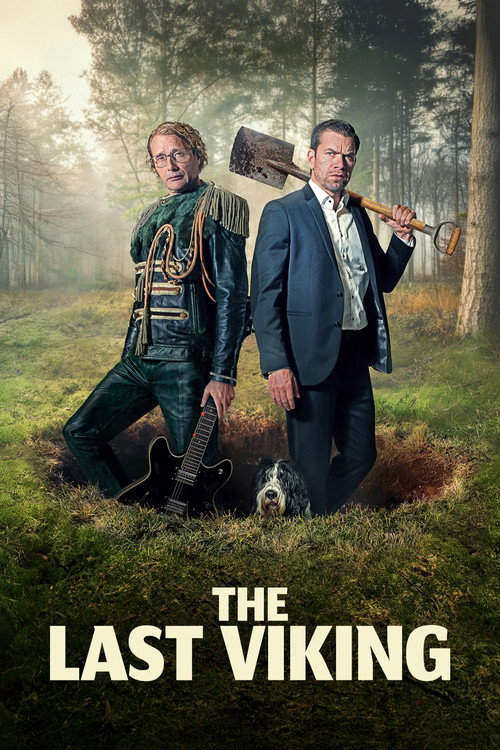




Anders Thomas Jensen doesn’t really make movies; he constructs carefully planned, emotionally unstable experiences disguised as stories about people. *Den sidste viking* is consistent with this approach, marking both a successful return to his established style and an expansion of the writer/director’s particular interests. It's a film that smoothly combines intense dramatic moments with bizarre humor, creating something that feels deeply affecting while also being unexpectedly funny. At its center, *The Last Viking* deals with problems between fathers and sons and the lasting effects of childhood experiences—a subject Jensen has explored before, but here it’s presented with stark honesty. The absurdity increases as Anker (Nikolaj Lie Kaas), recently released from prison for robbery, reconnects with his brother Manfred (Mads Mikkelsen), who was responsible for hiding the stolen money but now has dissociative identity disorder (DID). Their damaged, unhealthy, yet undeniable connection forms the emotional core of the film. Jensen’s familiar method is perfected in this work. The movie exists in a world slightly askew from our own, where serious human suffering clashes with the completely ridiculous. One moment you're confronting the painful consequences of childhood neglect, and the next you’re seeing a strange, slow-motion Viking fantasy or an odd argument at home involving old weapons. This balancing act is Jensen’s greatest accomplishment. Jensen cleverly expresses this internal conflict through a striking animated Viking story that runs throughout the narrative. It's not just added for show; it represents the son’s mind portrayed as a myth. The cartoon tale of heroes and monsters becomes a direct, sad metaphor for his desire for a brave father and his own struggle with deep-seated fear. The fable's heroic fantasy sharply contrasts with their harsh reality, making the emotional impact even stronger. Furthermore, Jensen makes this fable literal in the film’s most touching subplot: the relationship between the “ugly” man and his beautiful wife. This unusual couple—the severely burned man and the beautiful woman—becomes a real-life version of the fable. Initially, their relationship seems unequal, almost strange itself, based on contrast and appearance. But when the woman loses her beauty, their bond doesn’t break; it becomes clearer. Without illusions, their relationship grows stronger, more equal, and more brutally honest. In metaphorical terms, they fully enter the world of the animated fable: only after the promise of beauty in a fairy tale is destroyed can something genuine survive. In this way, the couple completes the fable’s message. The clever surprise? Jensen then increases both the entertainment value and the thematic depth by introducing a group of eccentric psychiatric patients into the protagonists' lives. These “lunatics,” each delightfully strange, act like a distorted mirror reflecting the main characters' own obsessions. Their chaotic escape provides hilarious, unpredictable comedy, while also subtly asking: who is truly dealing with things worse? Naturally, this being a Jensen film, the journey is filled with sudden, harsh violence—both releasing and disturbing—and dialogue that’s as sharp as any axe. *Den sidste viking* is a success. It's an important look at paternal failure and passed-down fear, packaged in the wild, bloody, and absurd style that only Anders Thomas Jensen can deliver. The animated fable elevates it from a good drama to a modern myth—a powerful, memorable film about the monsters we inherit and the heroes we must become to overcome them.
On September 29, 2026
#2845▼ 417
2845th by Pulse movie online10.7PULSEPulse MeterOur daily Pulse Meter measures public activity and popularity signals across the web.How it works →