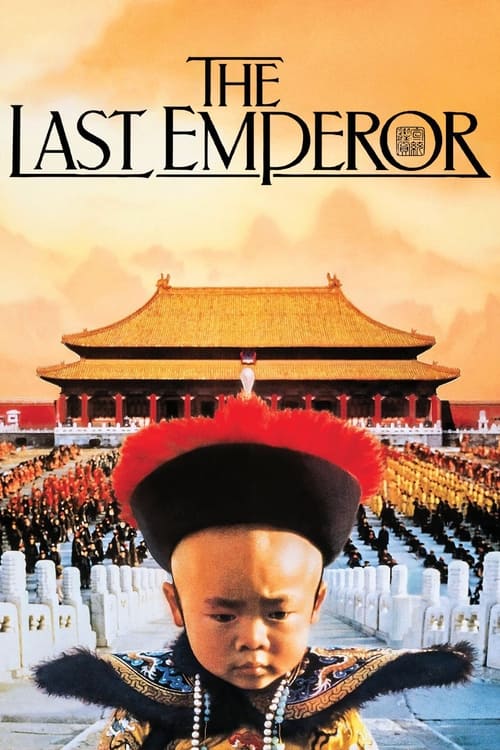





It’s truly something special to experience this film on a large screen. It portrays both the decline of an empire and the emergence of new ones—and it does so with striking color and style. With the Empress Dowager’s passing, the young Pu Yi takes his place on China's Dragon Throne, living among concubines and eunuchs within the Forbidden City. He initially believes he has a divinely ordained right to rule, but his perspective begins to shift when his tutor RJ (played by Peter O'Toole) enters the picture and provides him with spectacles, revealing that his world is contained within walls of golden yellow tiles. When external conflicts intrude upon this sheltered existence, the Emperor—now portrayed by John Lone—finds himself transformed into a playboy, bound to an opium-addicted wife (Joan Chen), and manipulated by the Japanese who have taken control of much of what was once his territory. World War II arrives, political power struggles unfold, and the story of his eventual, rather harsh, reintroduction into the newly formed Chinese communist society is shown with care and without excessive melodrama or sentimentality. The musical score contributes greatly to the film’s overall richness, but it's undoubtedly the cinematography that stands out. Filmed on location within the Imperial Palace complex in Peking, the movie conveys a wonderful sense of the grandeur, isolation, and luxury found inside this lavishly decorated collection of marble buildings and brightly painted villas, while outside, poverty and mysticism held greater sway than the person sitting on the throne. The costume design is also remarkable—the attention to detail for the period, spanning from the beginning to the middle of the 20th century, is spot-on. To be frank, the acting—with the exception of a captivating performance by the inquisitive and playful three-year-old (Richard Vuu)—is fairly standard. O'Toole’s role is limited, and he doesn’t quite embody the image of a learned and worldly scholar. Lone and Chen are adequate but their performances mainly highlight the somewhat stiff dialogue. This isn't primarily a film about what's being said; it's a visual experience. It explores history, politics, corruption, betrayal—and even touches on love—all presented within an elegant framework of creativity. It’s not something you want to watch on television, but it is certainly one of the finest examples of epic cinema ever made, and Bertolucci clearly poured himself into this beautiful drama. I would definitely recommend seeing it.
On September 29, 2026
#1052▼ 13
1052nd by Pulse movie online52.7PULSEPulse MeterOur daily Pulse Meter measures public activity and popularity signals across the web.How it works →