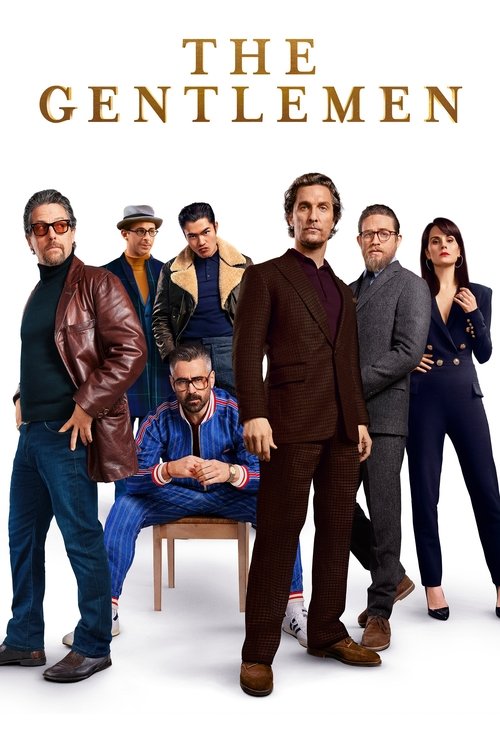





It’s not entirely surprising, but it manages to be quite amusing and highly entertaining. “You don't crucify people! Not on Good Friday!” - Harold Shand; _The Long Good Friday_ (1980) _The Gentlemen_ marks Guy Ritchie’s return to the London gangster world that launched his career with films like _Lock, Stock and Two Smoking Barrels_ (1998) and _Snatch._ (2000). This is his first venture back into this territory since the disappointing _RocknRolla_ (2008), following a period of making large-scale studio productions such as _Sherlock Holmes_ (2009), _Sherlock Holmes: A Game of Shadows_ (2011), _The Man from U.N.C.L.E_. (2015), _King Arthur: Legend of the Sword_ (2017), and _Aladdin_ (2019). While the film does feel dated in some respects, it’s hard to deny that it's a blast. It's questionable that the only gay character is portrayed as a sleazy man-whore into S&M, the token female character barely registers as anything more than a placeholder, and Ritchie doesn’t offer any fresh ideas – those who have seen _Lock, Stock_ or _Snatch._ will find themselves familiar with what's on offer – but _The Gentlemen_ is still hugely entertaining. The jokes generally land well, the dialogue remains sharp and full of expletives, and the cast seems to be having a great time. Self-awareness works effectively for the most part. Although the plot feels derivative, Ritchie brings real energy to what appears to be a fairly standard crime film. _The Gentlemen_ isn’t likely to change your life, but it will certainly make you laugh. The story begins with sleazy private investigator Fletcher (Hugh Grant) making an unannounced visit to Ray's (Charlie Hunnam) home. Ray is the right-hand man of Mickey Pearson (Matthew McConaughey), a sophisticated American expatriate who controls a substantial marijuana empire in London, valued at approximately £400 million. Several months earlier, Fletcher was hired by tabloid editor Big Dave (Eddie Marsen) to dig up dirt on Pearson as revenge for being snubbed at a gala event. Fletcher has crafted a screenplay based on his investigation (titled _Bush_) and informs Ray that he will hand over the information to Dave unless Pearson pays him £20 million. Meanwhile, Pearson intends to sell his entire operation, but when news of this spreads, chaos erupts as various interested parties attempt to gain an advantage. Much of the film unfolds through Fletcher narrating his experiences to Ray, explaining how he uncovered so much about Pearson and his operations. Along the way, we encounter characters such as Rosalind (Michelle Dockery), Pearson’s ruthless and composed _“cockney Cleopatra”_ wife who manages a garage staffed entirely by women; Berger (Jeremy Strong), Pearson's preferred buyer; Dry Eye (Henry Golding), an ambitious but brutal scion of a Chinese syndicate hoping to undermine Berger; Coach (Colin Farrell, in a memorable performance), who runs a boxing gym for troubled youths and finds himself unexpectedly involved; numerous property-rich but cash-poor landowners essential to Pearson’s empire; a Russian oligarch; and a street gang called The Toddlers. The film's aesthetic is consistent with Ritchie’s earlier gangster movies. Because Fletcher frames his narration as a screenplay, Ritchie uses various self-referential techniques – a sudden cut synchronized with Fletcher asking Ray to imagine one; voiceover transitioning into spoken dialogue; on-screen captions identifying characters; animated maps; YouTube videos of fights (the specifics are best left unmentioned); freeze-frames; rewinds; and even a shot of film running through a projector. At one point, Fletcher discusses the merits of anamorphic (2.39:1) versus 1.78:1 aspect ratios, and the film's aspect ratio changes accordingly. In another instance, he champions 35mm celluloid over digital formats, noting his preference for the graininess of film stock, and the film switches to that format. This playful approach prevents the film from taking itself too seriously, with perhaps the most self-aware moment occurring when we visit Miramax’s London offices (Miramax produced the movie) and see a poster for Ritchie's _The Man From U.N.C.L.E._. All of this is quite entertaining, especially if you have some familiarity with filmmaking techniques – Fletcher even acknowledges his own unreliability as a narrator, and a discussion about sound leads to his dismissal of Francis Ford Coppola’s _The Conversation_ (1974) as "_a bit boring._" The film explores familiar themes that Ritchie has addressed before: the idea that the economic divide between gangsters and aristocrats obscures their similarities. Pearson embodies this duality; he's a gangster, but also possesses qualities of an aristocrat, and his business relies on both classes – the aristocrats who cultivate his product (for reasons I won’t spoil) and the gangsters who distribute it. The contrast between the pompous insularity of the English upper class and the perceived uncouthness of the lower class has been explored in literature (such as Emily Brontë's _Wuthering Heights_ (1847)) and film (like Nicolas Roeg and Donald Cammell’s _Performance_ (1970)), but Ritchie doesn't offer any new insights, although it does create an interesting backdrop – gentrification is evident; there are ironic references to affluent areas of Croydon; Ray, a working-class Newcastle native, is obsessed with cleanliness, enjoys wagyu steak, and lives in a mansion, and he expresses disdain when sent on a mission to a less privileged area. A particularly striking scene depicts a group of wealthy teenagers holed up in a council flat while machete-wielding delinquents terrorize the neighborhood below. As Ray and his men confront the gang, there’s a palpable sense of old versus new – traditional gangsters clashing with internet-savvy hoodlums who disregard tradition and respect. There are plenty of laughs to be had from these situations, such as Ray and Coach struggling to pronounce the name Phuc or Coach debating whether calling someone "_a black c**t_" is racist, even though they are both Black men. Again, none of this is presented with any seriousness. The film's main shortcomings lie in its lack of depth and the familiarity of its presentation, characters, and setting – there’s nothing here that hasn’t been seen in Ritchie’s previous films. As expected, it lacks emotional maturity or narrative complexity; it makes no attempt to hide this. Despite these flaws, I thoroughly enjoyed _The Gentlemen_. It's a hilarious caper with actors who are clearly having a great time. While formulaic and familiar, it remains immensely enjoyable.
On September 26, 2026
#220▼ 2
220th by Pulse movie online61.4PULSEPulse MeterOur daily Pulse Meter measures public activity and popularity signals across the web.How it works →