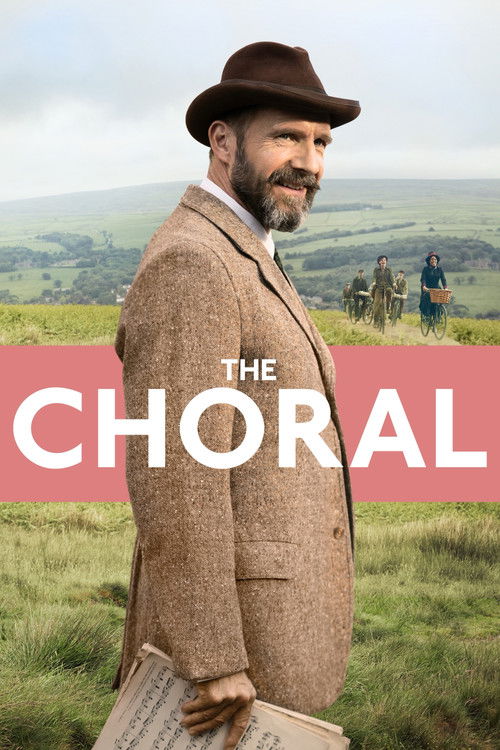





The story unfolds in a northern English town called “Ramsden” during World War I, when many still anticipated a swift end to the conflict. The community faces a problem: their choir director has enlisted, leaving St Matthew’s Passion—already scheduled for the town hall—without leadership. Mill owner “Duxbury” (Roger Allam), along with his companions "Joe" (Mark Addy) and undertaker “Trickett” (Alun Armstrong), decides on “Guthrie” (Ralph Fiennes) as a replacement, despite his German background and the fact that much of the music they need is also German in origin. Aware of the potential political fallout and struggling to find male singers among the dwindling population, the film follows their attempts to stage a large choral work by Sir Edward Elgar. Simultaneously, we see several young men from the town, around seventeen years old, facing imminent conscription and preoccupied with romantic encounters—whether tender or casual. “Ellis” (Taylor Uttley) desires “Bella” (Emily Fairn), but she is engaged to the recently returned and injured "Clyde" (Jacob Dudman). Other characters include postman “Lofty” (Oliver Briscombe), Salvation Army singer “Mary” (Amara Okereke), and her hopeful suitor, “Mitch” (Shaun Thomas). A separate storyline between “Guthrie” and pianist “Robert” (Robert Emms) felt somewhat unnecessary to me, seemingly intended to explore themes of conscientious objection. The narrative raises questions about whether any of these characters will find happiness before the performance or before departure on a train. It also wonders if Sir Edward himself will permit them to perform his work. While historians might identify inaccuracies in the film’s depiction of events, I believe it's fundamentally about how ordinary people navigated a war they understood little about beyond their loyalty and commitment to King and Country. The premise requires some suspension of disbelief regarding the town’s ability to assemble such a talented group of singers; however, it evoked similarities to “Brassed Off” (1996), highlighting the vital role choirs and bands played in working-class communities, enabling them to tackle complex pieces with determination that surpassed social divisions. This sense of purpose is what I felt the film conveyed effectively. Although Ralph Fiennes’s performance was largely limited to clear German enunciation, Roger Allam, Emily Fairn, and Amara Okereke—who stole several scenes—provided an agreeable portrayal of the importance of wartime distraction for those already at or about to go to the Somme. The production design is detailed and convincing; sugar rationing seems nonexistent when it comes to Battenberg cakes, and Sir Simon delivered a brief but memorable performance as a curmudgeonly artist reminiscent of his “Downton Abbey” work. The choral piece featured prominently during the closing credits, and while this might not be a film that lingers in one’s memory for long, I found its underlying humanity—mixed with occasional humor—to be quite touching and worth seeing.
On September 29, 2026
#11995▼ 1091
11995th by Pulse movie online3.9PULSEPulse MeterOur daily Pulse Meter measures public activity and popularity signals across the web.How it works →