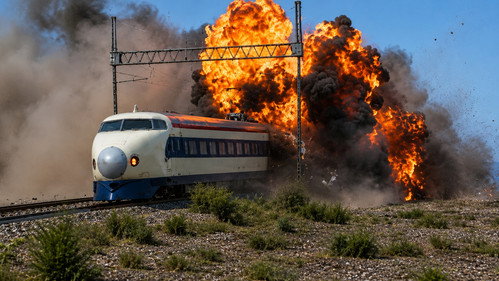





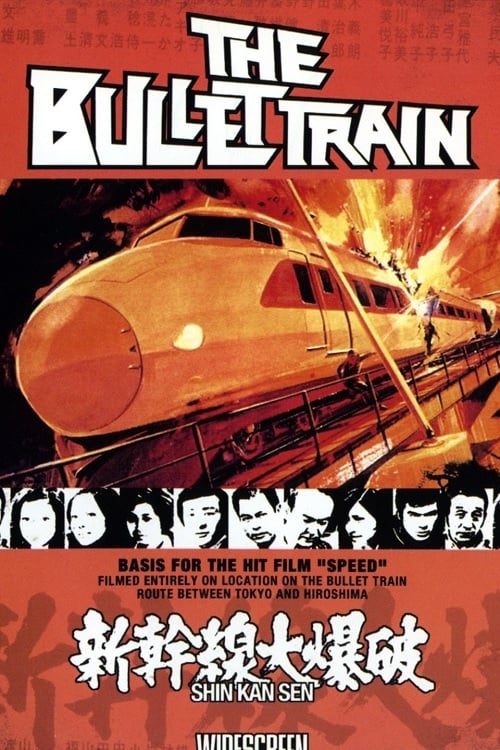
During the early 1970s, disaster films began to gain popularity with movies such as *Airport* (1970), *The Poseidon Adventure* (1972), *The Towering Inferno* (1974), and *Earthquake* (1974), which were successful both domestically and internationally. Toei, a major Japanese film studio at the time, noticed this trend and sought to capitalize on it. Japan’s first two bullet train lines, Tokaido and San'yō, had opened in 1964 and 1972, respectively, and the Shinkansen was seen as an iconic symbol of the country. Toei enlisted journeyman director/writer Jun’ya Satô to adapt Arei Katô’s book into what would become Japan’s first major disaster film (excluding Kaiju films). Satô wrote the initial portion of the script, with Toei screenwriter Ryûnosuke Ono completing the remainder in roughly a month. Initially, Toei and Satô wanted Bunta Sugawara to play the lead role, Okita; however, his wife felt he wasn’t suited for the part because “the train was the main character.” The role then went to Ken-san, who had been trying to leave Toei for several years, in a deal that secured his participation. Yoshio Harada was originally slated to portray Koga, but casting issues arose, so Kei Yamamoto stepped into the role due to his resemblance to Harada. Following the formula of American disaster films, Toei also included Sonny Chiba, Tetsurō Tamba, Kunie Tanaka, Takashi Shimura, and others in prominent roles. Due to the Japanese title (*Shinkansen Daibakuha*, meaning "Bullet Train Big Explosion"), cooperation from the Japanese National Railway (JNR) was unavailable. A miniature bullet train model, scaled at 1/20th size, was created for most of the exterior action sequences. Filming wrapped up in approximately 40 days. *Shinkansen Daibakuha’s* narrative centers around three distinct groups: the JNR, the police, and a group of rebel bombers. Economic difficulties in Japan during the late 1960s and early 1970s had left many people struggling. Small business owners faced financial ruin, and young adults migrated from rural areas to work low-wage jobs in cities like Tokyo. The three bombers all came from backgrounds marked by economic hardship, motivating them to take drastic action. They decided to hijack a bullet train with explosives and demand billions of yen from the Japanese government. The Hikari 109 (“light train 109”) was traveling between Tokyo and Hakata along the Tokaido and San'yō bullet train lines, covering roughly 700 miles. The bombers, led by Ken-san, attached a bomb to the train and informed the JNR that it would detonate if the speed exceeded 50 mph (80 km/h). With only hours remaining to avert disaster, the JNR had to carefully guide the train across the extensive railway line. The police were tasked with tracking down the bombers and preventing the government from paying the ransom, sometimes clashing with the JNR command station’s instructions. Train personnel had to manage passenger anxiety (and eventual panic) without revealing the presence of a bomb onboard, creating suspenseful scenes throughout the film's lengthy runtime for all involved. The movie runs just over two and a half hours, which could present a challenge for some modern viewers. The extended length is due to the need to thoroughly resolve all plot threads involving the main characters. Unlike many films in the genre, Satô and his collaborators created sympathetic antagonists, exploring their humanity. The film suggests that they don’t desire to harm anyone but believe they deserve a better life—an ideology seen throughout history. Even with an immoral method, viewers are inclined to empathize with them and root for their success. Ken-san's screen presence and acting style contribute significantly to the film’s effectiveness as a disaster/crime drama; Bunta Sugawara, known for his menacing portrayals, would not have conveyed the same sense of stoicism. Several distinctive elements set this film apart from typical crime films. During tense moments, characters display exaggerated sweating—a characteristic Japanese facial close-up—and the soundtrack blends Lalo Schifrin’s *Dirty Harry* jazz score with Ennio Morricone's slow, swelling vocal harmonies from *A Fistful of Dynamite*. The set designs and locations are detailed and realistic; reportedly, a German actor posing as an engineer secretly filmed the actual JNR control room to provide Satô with reference material. The bomb wiring explanation is plausible and based on Satô’s experience with radios. Finally, while the character Aoki was intended to be passive, Sonny Chiba's performance brought energy and depth to the train scenes that weren't originally in the script. *Bullet Train* initially underperformed at the Japanese box office due to a lack of proper marketing from Toei. However, after achieving success on the French market six months later—released as *Super Express 109*—it was re-released in Japan with appropriate advertising and became a hit. Unfortunately, international versions were heavily edited, losing crucial backstory for the bombers and reducing the runtime to 115 minutes, which negatively impacted its reception in the United States. Nevertheless, it’s recognized as an inspiration for American action films like *Speed* (1994) and has earned its place alongside other essential Japanese disaster films such as *Ghidorah, the Three-Headed Monster* (1964) and Kenji Fukasaku’s *Virus* (1980).
On September 22, 2026
#17203▼ 110
17203rd by Pulse movie online26.7PULSEPulse MeterOur daily Pulse Meter measures public activity and popularity signals across the web.How it works →