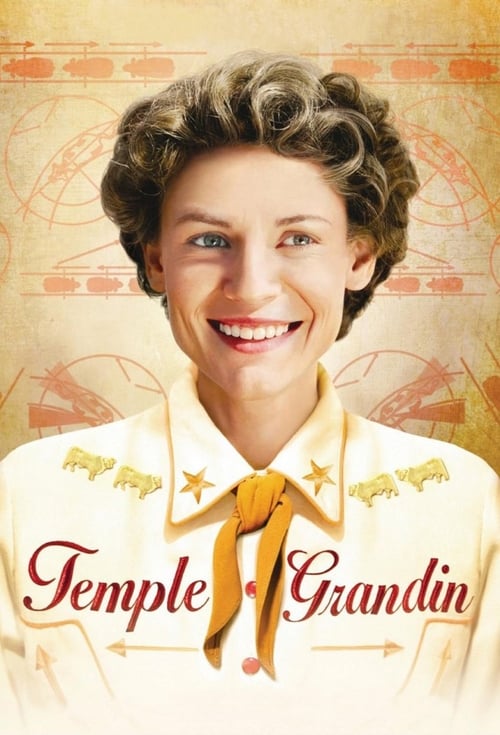





After graduating from high school, Temple Grandin is sent to her Aunt Ann’s ranch in Arizona. Her initial discomfort with the environment and unusual behavior quickly suggests she has Asperger's Syndrome or autism—a milder form of autism characterized by better communication skills but difficulty connecting with societal norms. Temple develops a fondness for the ranch, working with animals and devising an automatic gate operated by a brass rod. She is intelligent and detail-oriented, but must pursue higher education. Throughout her life, Temple’s mother has managed her daughter's outbursts and understands how to soothe her. College proves challenging; Temple constructs a machine that helps her feel calm but shocks other students—it resembles a cattle hold. Thrust into this environment before the availability of special services, she perseveres and eventually earns a master's degree in animal husbandry back in Arizona. There, she encounters resistance from cattlemen who dismiss her research on cow vocalizations and object to her being a woman in their field. Temple pioneers a more humane method for medicating cattle and reconsiders the process of slaughtering them. She believes animals exist for human use but that kindness is both sensible and good business practice. Temple possesses a unique perspective, interpreting language literally and perceiving the world as images. Concepts like death are foreign to her; when someone dies, she wonders where they’ve gone and struggles with funeral rituals. Grandin later became an advocate for autism after writing technical ranching journals, and the screenplay is based on two books she authored. Mick Jackson's direction is exceptional, using special effects effectively to illustrate how Grandin visualizes things—a valuable learning experience that demonstrates autistic individuals are different, not deficient (as Temple’s mother puts it). Although the narrative occasionally shifts between time periods, it maintains its focus on Grandin. While the supporting cast has their moments, the film centers around a captivating central character who doesn't rely on melodrama. Catherine O’Hara excels as Aunt Ann, demonstrating her deep understanding of her niece. Julia Ormond delivers a phenomenal performance as Temple’s mother, portraying the guilt and worry of raising a child with a condition she feels responsible for. David Strathairn is also wonderful as Temple’s science professor, recognizing her brilliance and adapting coursework to suit her learning style. Claire Danes gives an extraordinary performance; while previously considered good in films like “Romeo + Juliet” and “Terminator 2,” her earlier role in "My So-Called Life" was grating. Having seen interviews with the real Temple Grandin, Danes doesn't simply mimic mannerisms—she embodies the character completely. Her portrayal is accurate from the very beginning and consistently convincing. The performance is so compelling that it’s easy to forget you are watching an actress; it’s among the best I have ever witnessed, and I’ve been involved in film review since elementary school. I thoroughly enjoyed "Temple Grandin," connecting with its themes thanks to my own family experiences, but others will likely find inspiration as well. This work could demonstrate to artists the power of film to affect audiences.
On September 29, 2026
#2859▼ 321
2859th by Pulse movie online10.7PULSEPulse MeterOur daily Pulse Meter measures public activity and popularity signals across the web.How it works →