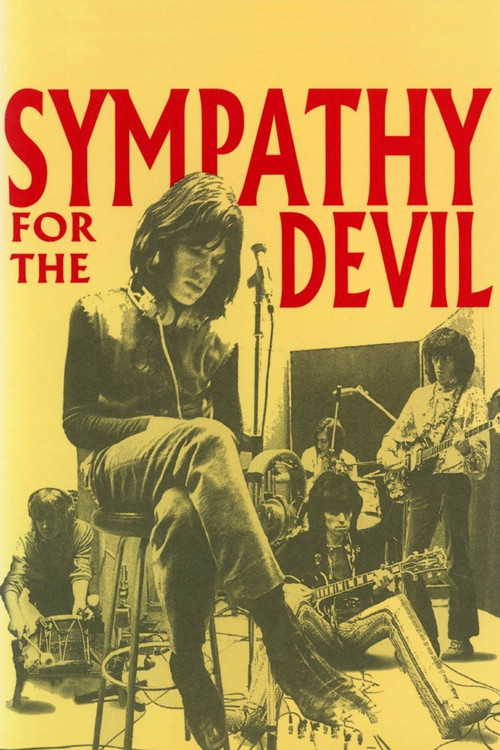





It’s rare to find a movie that manages to blend a broadly appealing subject with one that's likely to confuse or alienate the very audience it aims to reach. Jean-Luc Godard's *Sympathy for the Devil* will probably thrill some viewers while frustrating others. How does one even assign a rating to something like this? In May of 1968, Jean-Luc Godard was allowed to film the Rolling Stones as they developed their well-known song "Sympathy for the Devil" over several days in a London studio. One might reasonably expect a straightforward documentary about how a rock band creates music. However, by that point, Godard had already distanced himself from traditional filmmaking and began exploring using cinema to promote Maoist ideology, which he considered representative of the era’s spirit. Consequently, we barely get to see the Stones working before Godard abruptly shifts to entirely different footage involving readings of politically charged texts. Throughout the film, there's a constant back-and-forth between scenes of the Rolling Stones in the studio and political imagery: Black Panthers discussing revolution around a junkyard, a woman spray-painting Maoist slogans on London walls, a comic book shop used as a metaphor for American imperialism, and so on. Even if the combination feels jarring and somewhat silly, the segments featuring the Rolling Stones are enjoyable for fans of their music. The viewer gets to witness the evolution of "Sympathy for the Devil," from Mick Jagger’s initial idea that he has to teach Keith Richards to play, to the finished version with congas and backing vocals that was eventually released. Unbeknownst to Godard at the time, the film also inadvertently provides a portrait of Brian Jones' decline, occurring just a year before his death: he appears sporadically in the studio, seemingly ignored by his bandmates while strumming an unamplified guitar. The other members of the Stones appear to be having fun. It’s amusing to observe how Jagger’s typically affected English accent transforms into an imitation of an old American bluesman as soon as each take begins; I've rarely felt so strongly how much blues music resonated with that generation of young Englishmen. The film concludes with a lengthy jam session by the band, presumably after finishing "Sympathy for the Devil." Another appealing aspect for music enthusiasts is seeing what recording studios looked like in the 1960s, complete with the technology and soundproofing techniques of that period (and everyone smoking constantly—the place must have smelled strongly of smoke). What about the political portions? They’ll likely perplex anyone unfamiliar with Godard's work from the late 1960s. However, if you watch his films in order, there's a clear progression stemming from *Weekend*, his last relatively conventional film: we see a depiction of the breakdown of consumerist society through images of militants wielding guns against people covered in (deliberately fake) blood. Anne Wiazemsky, who had previously appeared in Godard’s films as a symbol of rebellious youth and was then his second wife, portrays "Eve Democracy." Unable to respond to her interviewer's questions other than “Yes” or “No,” she satirizes what Godard perceived as the impotence of representative democracy, where citizens have limited options for political change beyond voting every few years despite facing urgent issues. Godard’s politics at this time seemed erratic, and it’s difficult to know how genuinely he believed in Maoism, or whether the 38-year-old director was simply adopting a trend to connect with younger people. Nevertheless, for those interested in history, especially that turbulent decade, even the political scenes can be of interest. During the segment set in the comic book shop, the camera slowly pans across shelves displaying pulp literature and pornography that has since been forgotten. Despite being somewhat preachy, the scenes featuring the Black Panthers and Eve Democracy can still be appreciated as a glimpse into 1960s fashion thanks to the characters’ vibrant clothing.
On September 25, 2026
#22385▲ 42386
22385th by Pulse movie online21.6PULSEPulse MeterOur daily Pulse Meter measures public activity and popularity signals across the web.How it works →