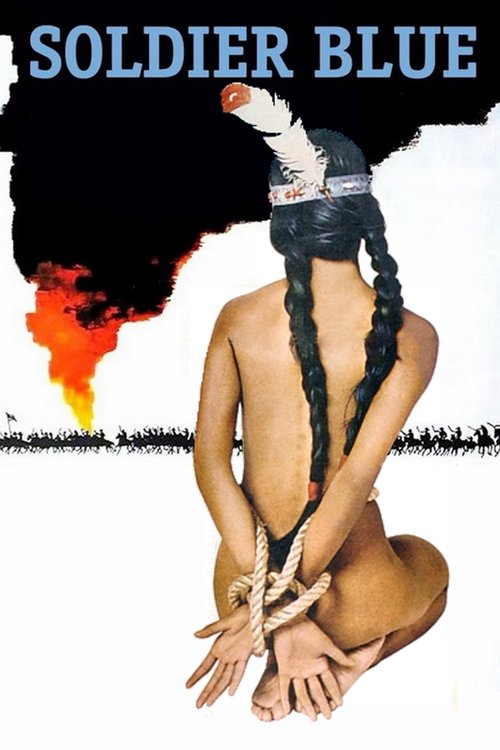





"Soldier Blue" (1970) presents itself as a lighthearted Western romance but is framed by scenes of shocking violence. The story follows a soldier and an Indian sympathizer, portrayed by Peter Strauss and Candice Bergen, who must journey back to the fort after a cavalry unit is wiped out by the Cheyenne in 1877. Initially, the man struggles with his feelings toward her unconventional views, but eventually witnesses disturbing events firsthand. The film’s unusual nature stems from its combination of a charming romance between a patriotic soldier and a free-spirited woman who thrives outside societal constraints, contrasted with brutal massacres: one led by Cheyenne warriors against soldiers, and another depicting the military's attack on a peaceful Cheyenne camp—a clear reference to the Sand Creek Massacre of 1864. While I appreciate that the film attempts to portray violence from both sides, it seems to favor the Native American perspective by showing Caucasian forces attacking women and children while not demonstrating similar actions committed against them. The narrative guides the viewer along with Honus’s evolving understanding: he begins viewing Indians as ruthless murderers but ultimately realizes his own people are capable of barbarity too. The film's focus on injustices suffered by the US military or settlers is consistent with a trend that began in the 1960s and 70s, alongside films like "Wounded Knee," "Bear River," and “Tell Them Willie Boy Is Here.” However, it neglects to explore the events that provoked these conflicts, including atrocities committed by Native Americans against settlers. For instance, the Dakota War of 1862 saw Santee Sioux killing between 600 and 800 civilians—the highest death toll inflicted on American civilians until 9/11. Other incidents like the Ward Massacre, the Nez Perce uprising, and the Fort Mims massacre are also left unexamined, as are the countless instances of settlers being murdered by Native Americans while peace treaties were being signed. It’s easy to sympathize with Native Americans from a position of safety, but it's another matter when your own life and those of your loved ones are threatened with torture and slaughter in the wilderness. Both sides desired what the other possessed: settlers wanted land and resources, while Native Americans coveted advanced technology. Treaties were used as tools for both groups to achieve their goals, resorting to conflict when necessary. It’s worth noting that John Chivington, the leader of the attack on the Sand Creek camp, was not a regular Army officer but rather a militia leader in Colorado during the Civil War. His actions were separate from official government policy and condemned by Captain Silas Soule as unjust. As someone with Abenaki heritage who admires Native American culture, I find the tendency to gloss over their wrongdoings and rewrite history misleading and unfair. "Soldier Blue" contributes to this issue but manages to offer a degree of balance, making it worthwhile despite its leaning toward the Native American perspective. The film runs for 1 hour and 52 minutes, filmed in Chihuahua and Sonora, Mexico. GRADE: B
On September 26, 2026
#12960
12960th by Pulse movie online24.7PULSEPulse MeterOur daily Pulse Meter measures public activity and popularity signals across the web.How it works →