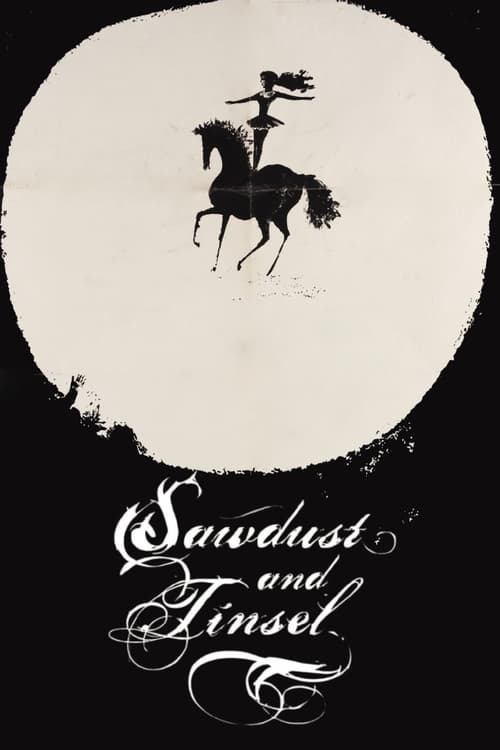




The central idea in Ingmar Bergman’s 1953 film *Gycklarnas afton* (*"The Evening of the Clowns"*, also known as "Sawdust and Tinsel" and "The Naked Night") seems to be that life itself is inescapable, like a circus. The movie begins with a circus traveling toward a small Swedish town in the early 20th century. An introductory story told by a coachman recounts an embarrassing incident involving a clown and his wife, establishing a pattern of humiliation that appears throughout the film. Following this, there's a flashback sequence where characters’ mouths move but no sound is audible—a nod to silent-era director Sergei Eisenstein. The main storyline then unfolds: circus director Albert (Åke Grönberg) plans to use his return visit to this town as an opportunity to see his wife and children, whom he deserted three years earlier. His mistress, Anne (Harriet Andersson), becomes jealous and wants to leave the circus, so she allows a local actor (Hasse Ekman) to seduce her. The film reaches its peak during the circus performance, where all the underlying tensions erupt, though not in the way I anticipated. This isn’t representative of Bergman's later, more accomplished work. Those who expect the profound explorations of faith and relationships that characterize his later films will likely find this a rather simple melodrama. The symbolism feels overly obvious, and even with its relatively short 90-minute length, the film feels stretched out for what it provides. I wasn’t prepared for Bergman to include an extended scene where a stressed character sweats and collapses, only to have that same type of drawn-out sequence repeated later on. Despite this, there are some worthwhile aspects. Anders Ek's performance stands out as particularly memorable; his supporting role is as a clown with very particular physical movements. It’s quite different from the stern priests he would portray in two subsequent Bergman films. I can't help but wonder if his unusual way of moving his mouth influenced the appearance of the buck-toothed drunks featured in *Saturday Night Live*'s "Bill Brasky" sketches. The film’s score, composed by Karl-Birger Blomdahl—who would later become known as Sweden's most controversial avant-garde composer—is reminiscent of Hindemith and incorporates references to popular dances, effectively capturing the lively and crude atmosphere of both the circus performers and townspeople. It’s an interesting bit of background that before Criterion released a DVD, the film was unavailable in the United States and only known from its initial theatrical run, where the American distributor marketed it as a scandalous exploitation film. I find this puzzling, and it suggests the 1950s were likely a very constrained time. While Harriet Andersson embodies a seductive persona for the era, her role is largely defined by her appearance; the eroticism isn’t particularly intense.
On October 4, 2026
#51733
51733rd by Pulse movie online1.5PULSEPulse MeterOur daily Pulse Meter measures public activity and popularity signals across the web.How it works →














