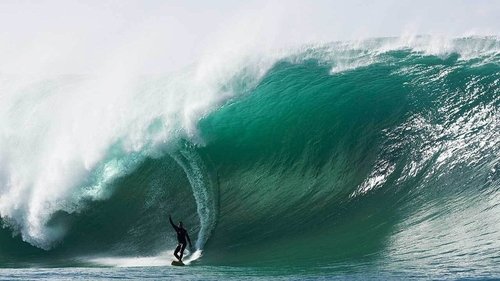





You have to wonder just how perilous the "graveyard" could possibly be if Clark managed to survive it alone for 15 years. Then word of Mavericks spreads, and renowned surfers from Hawaii's North Shore come to check it out. One of the sport’s top competitors, Mark Foo, dies after falling on a moderately sized wave. Some believe his leash got tangled on rocks, leading to drowning. Another surfer thought he sensed or felt something beneath the surface that shouldn’t have been there. Exactly one year later, during a memorial service for Foo, another surfer also drowns. The documentary "Riding Giants" shows surfers discussing and mourning the lost men. Jeff Clark isn't shown during those earlier 15 years because he was by himself. And it was quite an existence, to plunge into the frigid ocean and swim out for nearly an hour just to experience a few seconds of exhilaration while risking everything. Clark and his peers embody courage, madness, skill, and obsession. Consider Laird Hamilton, currently considered surfing’s top star, who has capitalized on his fame with endorsement deals, modeling assignments, and magazine covers. However, I'm not criticizing him; he is also an exceptional athlete and a very driven person. Growing up in Hawaii, he introduced his divorced mother to one of the big wave riders, who became her partner and mentor; Laird grew into surfing’s first true superstar. What Hamilton has done is venture farther from shore than anyone previously imagined, searching for “remote offshore reefs capable of producing unimaginable waves.” Initially, this involved paddling for two hours and then waiting up to another two hours for a wave. Then Hamilton developed "towing surfing," using a jet ski to tow him out to those distant reefs so he could ride waves moving too fast to access any other way. The jet ski operator’s additional responsibility is to retrieve Hamilton after the ride, or be ready to rescue him. The recent thriller "Open Water" depicts a couple lost at sea after being abandoned by a scuba-diving tour. For Hamilton, being lost at sea is a real possibility multiple times each day. “Riding Giants,” directed by Stacy Peralta, whose "Dogtown and Z-Boys" (2002) documented the birth and culture of Southern California skateboarding, relies heavily on archival footage. He seems to have access to an endless supply of historical material, sometimes in home movie form; we see Hamilton during the early days of towing surfing, when it was initially dismissed before eventually being embraced by the sport’s leading figures. In August 2000, Hamilton traveled to Tahiti seeking a legendary wave so massive it's described as "a freak of hydroponics." He found it and rode it, and we see him precariously balanced on its immense size in what the film calls “the most significant ride in surfing history.” Other surfers, providing voiceover commentary, say that the wave’s characteristics were so unlike typical waves that Hamilton had to invent new techniques on the spot, some of which defied years of established surfing theory and instinct. It feels like a long time since that summer of 1967 when I sat in a Chicago beer garden with Bruce Brown, who was tanned and cheerful. He’d just made a documentary called "The Endless Summer," and he was touring the country with it at a moment when surfing was becoming incredibly popular (there were 5,000 surfers in 1959, compared to 2 million today). For Brown, surfing was simply fun. With a $50,000 budget, he followed two surfers on an adventure that took them to Senegal, Ghana, South Africa, Australia, New Zealand, Tahiti and Hawaii. They were searching for the "perfect wave," and they found it off Durban, South Africa: “A 4-foot curl that gave rides of 15 minutes and came in so steadily it looked like it was made by a machine.” Just a 4-foot curl? Hamilton and his contemporaries are tackling waves of 60 or 70 feet. "The Endless Summer" portrays a world of beaches, beautiful women, beer, and Beach Boys songs, with surfers who live to “get stoked." In contrast, "Riding Giants" depicts the sport as more like an endless winter—lonely and dangerous. Even while Brown was making "The Endless Summer," modern surfing was being pioneered by figures like Greg Noll of Hawaii, who ventured 15 miles up the coast from Honolulu to Waimea Bay. It was considered impossible to surf; one surfer asks himself, “can the human body survive the wipeout?” The answer was yes. Discovering Oahu's North Shore, the movie says, "was surfing's equivalent of Columbus discovering the New World." More vintage footage appears. A “storm of the century” hits Hawaii, and Noll, known as "The Bull," decides to surf it. His chances of survival were estimated at 50/50 by the film, but zero by anyone watching. He survived. It was “the biggest wave ever ridden"—until, perhaps, the monster Hamilton found off Tahiti, too large to measure. After Bruce Brown finds his Perfect Wave in "The Endless Summer," he exclaims: "The odds against a wave like this are 20 million to one!" The chances of Laird Hamilton getting stoked on a 4-foot curl are higher than that. Before seeing "Riding Giants," my understanding of surfing was shaped by the Gidget movies, “The Endless Summer,” the Beach Boys, Elvis and countless TV commercials. “Surfin’ Safari” was actually going through my head as I walked into the screening room. "Riding Giants" presents a completely different reality. The defining characteristic of these surfers is their level of obsession. They live to ride, and become depressed when there are no waves available. They haunt the edge of the sea like the sailors Melville describes on the first pages of Moby Dick. They seek the thrill of those moments when they balance atop a wave’s fury and feel themselves in precarious harmony with the uncontrollable power of the ocean. They are cold and tired, battered by waves, thrown against rocks, visited by sharks, held under so long they believe they are drowning—and over and over again, year after year, they return to the sea to do it all again.
On September 25, 2026
#19627▲ 30151
19627th by Pulse movie online23.6PULSEPulse MeterOur daily Pulse Meter measures public activity and popularity signals across the web.How it works →