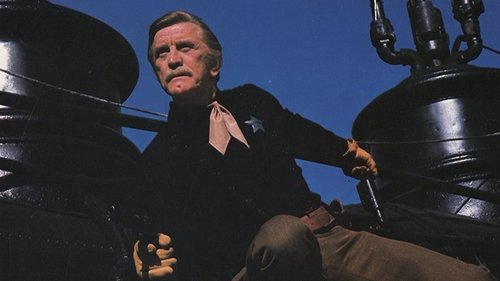




What happens when those considered “good guys” aren’t really all that different from the “bad guys”? "Posse," released in 1975, stars Kirk Douglas and Bruce Dern in a Western exploring this very question. Douglas portrays Nightingale, a marshal campaigning for Senate in West Texas, while Dern plays Strawhorn, an outlaw leader whom Nightingale wants to capture to boost his political prospects. Bo Hopkins appears as one of the marshal’s deputies, and James Stacy is on hand as a newspaper editor who opposes Nightingale's campaign. The film arrived shortly after Richard Nixon’s resignation amid the Watergate scandal, and "Posse" seems to capitalize on the public’s distrust of politicians. The movie contrasts Nightingale and his deputies with Strawhorn and his gang. While there isn't an obvious message throughout most of the film, it emerges in the final twenty minutes. Initially, the twist at the climax left me feeling uneasy and even disgusted, but after some thought, I began to understand what the filmmakers were trying to convey and found myself appreciating it. However, the way this point is presented feels a bit clumsy and could have been handled more smoothly. Some critics interpret the film's message as drawing parallels between a supposedly corrupt politician and an ostensibly honest lawbreaker, but that’s not quite accurate. Strawhorn isn't portrayed as a good guy; he’s clearly a violent criminal deserving of punishment. Nor is Nightingale depicted as deeply corrupt. He’s a respected marshal with political aspirations and connections to the railroad – so what? Even when tempted by Mrs. Ross (Beth Brickell), he politely declines, citing practical considerations. Isn't that a sign of wisdom—the ability to recognize and reject foolish or harmful desires? The film’s title itself offers insight into its message. Beyond its central theme, "Posse" is an enjoyable Western with interesting characters, a strong cast, and plenty of action. The movie has a running time of 92 minutes and was filmed in Arizona locations including Sabino Canyon, Florence, Sonoita, Aravaipa Canyon, and Old Tucson. GRADE: B-/C+ ***SPOILER ALERT*** (Do not continue if you haven’t seen the film) I struggled to accept the deputies' sudden decision to embrace a life of crime. While they would each receive $6000—an amount that would take three years to earn through honest work—it hardly seems enough to dramatically alter their lives, especially considering they would lose the prestige associated with their positions and the potential for advancement. This plot twist felt awkward and lowered my overall assessment of the film. However, there were hints earlier on that some of the deputies weren’t as virtuous as they appeared; one deputy refused to join them in crime. For example, at least three are shown secretly involved with young women from town, using a boxcar for trysts. These women were attracted to these "bad boys"—the very same “upstanding” deputies. What's surprising about that? Ultimately, the film suggests that the line between respectability and outlawry can be surprisingly thin; people can hold honest jobs while still being corrupt, essentially hiding their true nature. This happens everywhere all the time. One critic criticized the movie for its "tortuous confusion of good and evil." In reality, the film simply highlights the presence of corruption in places where people choose to ignore it—consider Hillary Clinton as an example. What about Nightingale himself? Was he complicit or just his men? I personally believe he was a driven marshal with political ambitions who refused to engage in inappropriate behavior. Yet, the fact that most of his deputies were corrupt casts a shadow on his judgment, suggesting he might be flawed as well—a flaw that could surface if he attained office. Despite my reservations, any film that prompts such questions is worth watching.
On September 23, 2026
#30560▼ 2883
30560th by Pulse movie online17.2PULSEPulse MeterOur daily Pulse Meter measures public activity and popularity signals across the web.How it works →














