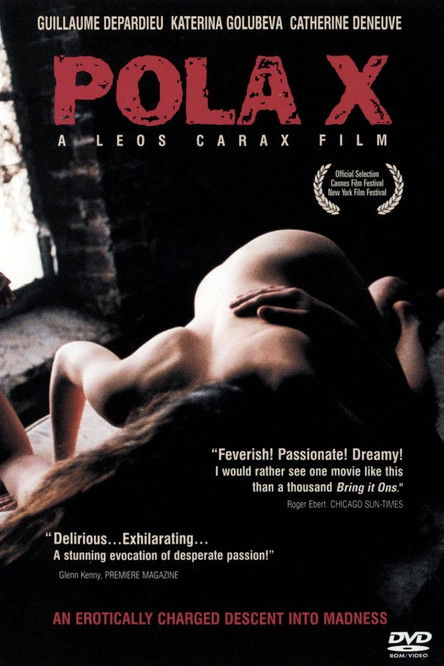




Leos Carax’s POLA X initially drew attention upon its 1999 release due to its depiction of an explicit sex scene, which was noted by both critics and audiences as part of the New French Extremity movement. However, this sequence represents a relatively short portion of the film's overall length. After twenty years, viewers should consider what the movie truly offers beyond that initial shock: a modern interpretation of Hermann Melville’s psychological novel PIERRE, and Carax’s integration of Melville's 19th-century setting of wealthy individuals with unsettling references to contemporary France, Bosnia, and the situation faced by Balkan refugees. Pierre (Guillaume Depardieu), the son of a formerly prominent diplomat, enjoys a comfortable life in rural France alongside his widowed mother (Catherine Deneuve). His existence appears favorable; a novel he authored has achieved bestseller status, and he is betrothed to Lucie (Delphine Chuillot). This changes when he encounters Isabelle (Yekaterina Golubeva), who claims to be his half-sister, born from his father’s relationship with an unidentified Balkan woman. Isabelle functions less as a conventional character and more like a spectral presence that permeates Pierre's life. Captivated by this enigmatic figure, Pierre abandons his privileged circumstances and embraces a vividly portrayed bohemian lifestyle, which ultimately leads to his physical and mental deterioration. POLA X relies on powerful visuals to convey its narrative rather than extensive dialogue. The dialogue itself is intentionally awkward, allowing the film to move between its foundation in Melville’s 19th-century novel. Much of Pierre's decline is communicated through contrasting imagery: the peaceful rural setting of the first portion and the harsh poverty he later chooses. This visual impact is so strong that even though POLA X might not be considered one of cinema’s greatest films, it has lingered in my thoughts since I saw it. A noteworthy element of POLA X is the collaboration between Carax and composer Scott Walker, who had recently released his acclaimed album TILT. As Pierre leaves home after meeting Isabelle, he joins a peculiar group of artists working within an industrial environment, whose avant-garde endeavors seem to conceal something sinister. It's at this point that Walker’s score shifts from the gentle strings of the film's opening to bolder, more forceful sounds. Carax structures the music so it functions both as part of the scene and as a commentary on Pierre’s psychological decline and contemporary political issues, contributing to the film's overall narrative.
On September 26, 2026
#13901
13901st by Pulse movie online23.9PULSEPulse MeterOur daily Pulse Meter measures public activity and popularity signals across the web.How it works →