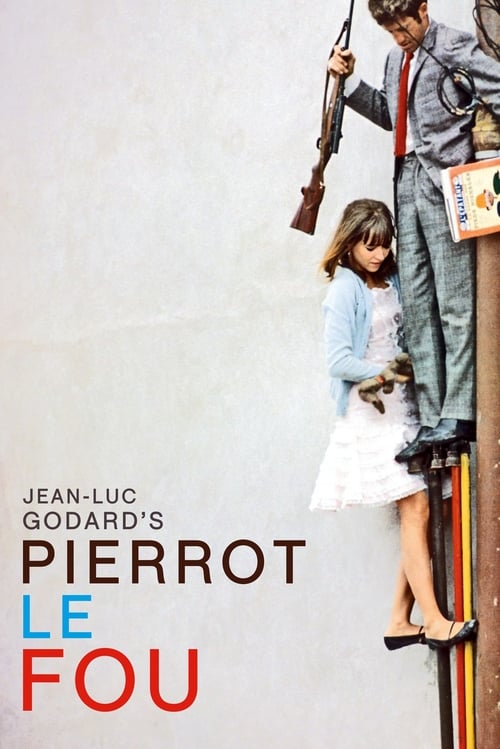




This is a truly rewarding movie experience that seems to take full advantage of what cinema can achieve. The French New Wave took inspiration from American crime stories, and Jean-Luc Godard's 1965 film PIERROT LE FOU has a fairly straightforward plot: Ferdinand (Jean-Paul Belmondo), five years into an unsatisfying marriage, reconnects with Marianne (Anna-Karina), his children’s babysitter and a former lover. Both desire to escape, and because Marianne already has involvement in the criminal world, they steal money and head toward southern France. As they pursue what they hope will be a better life, they inadvertently commit more crimes along the way. However, friction develops between them; Pierre is melancholy, preoccupied with literature, and pessimistic, while Marianne is spontaneous and unpredictable, uninterested in planning for the future. Confrontation with other gangsters in Nice brings matters to a climax. What elevates this beyond a standard thriller is the incredibly inventive manner in which the story unfolds, transforming it into an avant-garde masterpiece. Scenes are presented with exaggerated qualities, often becoming surreal metaphors representing events that the audience should understand have occurred. Two conversations between the lovers become musical numbers. Even during conventional thriller sequences like shootouts, Godard avoids any attempt at realism. The old Brechtian technique of alienation—where viewers are continually reminded they’re watching a performance and not reality—is used extensively. Furthermore, Godard addresses 1960s consumerism and the Vietnam War. It's certainly modernist and deeply personal, but PIERROT LE FOU is also accessible to those with an open mind because of its pop art aesthetic. The colors in the elaborate sets and landscapes are vibrant; it’s as if Godard and cinematographer Raoul Coutard perceived brighter hues than we do today and managed to capture that heightened sensory experience on film. Belmondo and Karina aren't only talented actors, they also have a strong chemistry together. Ultimately, PIERROT LE FOU is an emotionally resonant film. After my initial viewing, I felt as if something fundamental had shifted in my perspective, and I quickly arranged for another screening—the movie continues to impress with repeated viewings. I’m not sure this would be the ideal introduction to Godard's work. However, there's a particular satisfaction in watching his films in chronological order and arriving at PIERROT LE FOU after seeing his previous nine feature films. Godard filled this film with references to each of those earlier movies—details within the storytelling, costumes, music, and other elements. These subtle nods back to a productive career that had only begun six years prior are enjoyable for dedicated fans. The Criterion Collection released the film on Blu-Ray and DVD in 2008. Unfortunately, this edition quickly went out of print when Criterion lost North American distribution rights. That’s regrettable, as the Blu-Ray showcases this visually stunning movie in high definition and includes several worthwhile bonus features: a documentary about Godard and Karina's collaboration, an interview with Karina filmed specifically for Criterion, archival interviews with cast and crew, and a featurette where Jean-Pierre Gorin discusses the themes of PIERROT LE FOU over excerpts from the film.
On October 3, 2026
#16993
16993rd by Pulse movie online2.7PULSEPulse MeterOur daily Pulse Meter measures public activity and popularity signals across the web.How it works →