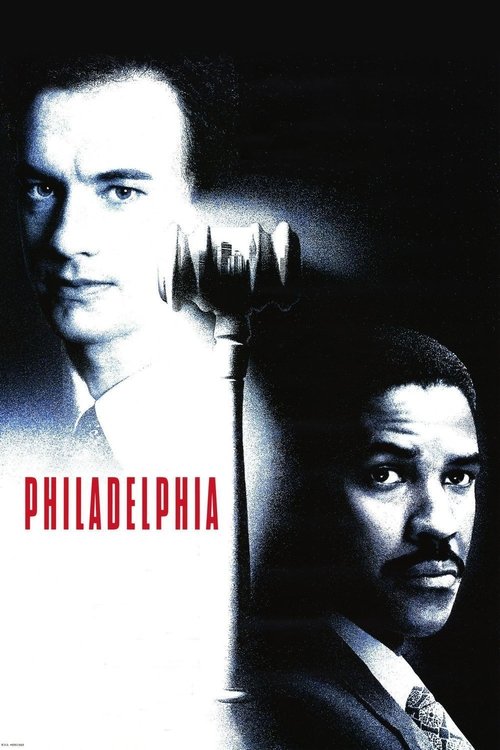




**A dense, disturbing, difficult, but highly relevant film.** Those who regularly read my writing might already know that I’m generally not a fan of films that are overly preachy, even when they address causes or ideas I support. For me, cinema is primarily about entertainment and artistic expression, rather than being a political statement or a social manifesto. However, it's hard to make an exception when the subject involves discrimination against people in the workplace. I imagine some readers might be thinking that the film isn’t really about that—that it’s about AIDS. That’s true, but AIDS serves as a way to justify what happens to the main character: he faces discrimination and loses his job because he is homosexual. I won't spend much time summarizing the plot. It's an older film, and most people have seen it at least once: Andrew Beckett, a young lawyer with a promising career, discovers that he has AIDS after a casual sexual encounter with another man. As the disease becomes more apparent to his employers, he is ultimately fired and decides to sue the firm, arguing that the real reason for his dismissal was their prejudice regarding his (previously hidden) homosexuality, which the illness revealed. The film is excellent and, at the time, did a great deal to demystify AIDS, a disease about which there was limited public knowledge and widespread fear due to a lack of understanding about its transmission. While we now have more information, it remains one of the most feared illnesses, alongside cancer or leukemia. However, the film didn’t completely separate AIDS from homosexuality. I understand why: diseases like this can spread easily in social circles with more liberal sexual attitudes, and many people within the GLBT community do not always have stable relationships. Nevertheless, we now know that AIDS can be contracted by heterosexuals who don't take precautions. In fact, I tend to associate AIDS more strongly with drug users, given the risks they face when using drugs in unsanitary environments and sharing needles. Beyond its important and weighty theme, which guarantees it a relevance and significance it might not otherwise possess, there’s another reason this film was successful and had such an impact: Tom Hanks. This role definitely broadened his career possibilities and significantly contributed to making him one of the most beloved actors in America. He was still relatively young at that point, emerging from a period where he'd done many quality comedies, and the film offered him a chance to showcase his serious and dramatic side. The actor clearly made the most of every moment, delivering one of his most significant performances, an ordeal that earned him the Oscar for Best Actor—a feat he repeated the following year with “Forrest Gump.” Remarkable! Alongside him is Denzel Washington, who remains consistently energetic and captivating; it’s not easy to overshadow someone with such charisma! I don't think this film deserves exceptionally high marks based on its technical aspects. The director, Jonathan Demme, wisely avoided overwhelming the film with unnecessary visual or sound effects. It’s a straightforward, clean production, with dialogue as direct as a physical blow to the audience. And it is certainly one of those films that is difficult to watch, makes you think, and doesn't leave you feeling happy. Regardless, the cinematography, sets, and costumes are well done, and the courtroom scenes (filmed in an actual courtroom) add to their realism. While Bruce Springsteen rightfully received the Oscar for Original Song “Streets of Philadelphia” (which we hear almost entirely during a lengthy opening credits sequence), one of his greatest hits, I also want to mention the opera arias used throughout the film—mostly recordings of Maria Callas from various operas such as "Adriana Lecouvreur," "La Vestale," or "Andrea Chénier.” The contrast between the raw nature of the film and its themes with the sublime beauty and lyricism of these melodies is striking.
On September 27, 2026
#1719▼ 803
1719th by Pulse movie online50.7PULSEPulse MeterOur daily Pulse Meter measures public activity and popularity signals across the web.How it works →