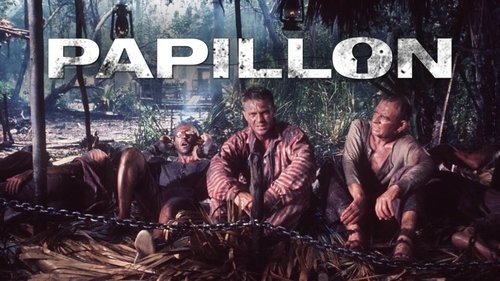




This is a stark, genuine portrayal of Henri "Papillon" Charrière’s experiences at Devil’s Island. Directed by Franklin J. Schaffner (of *Planet Of The Apes* and *Patton*), *Papillon* is based on the autobiography of notorious French convict Henri “Papillon” Charrière, adapted for the screen by Dalton Trumbo & Lorenzo Semple Jr.. Steve McQueen portrays Papillon, with Dustin Hoffman as Louis Dega. Filming took place primarily in Jamaica and Spain, with Fred J. Koenekamp handling cinematography and Jerry Goldsmith composing the score. Henri "Papillon" Charrière was a criminal who found himself sent to Devil's Island—a prison fortress considered inescapable—for a murder he didn’t commit. The film, like the book it is based on, presents a fictionalized account of Charrière’s time at the penal colony. It’s probably best described as a compelling drama centered around friendship under intense pressure, resilience, and taking advantage of opportunities, all interwoven with an adventurous spirit. Schaffner directs with considerable skill; despite minimal dialogue, he effectively creates a stifling atmosphere, which is essential for conveying the harshness of life in this prison colony. The film doesn't shy away from portraying the reality of their situation—it avoids softening things up with Hollywood sentimentality and instead captures the true feeling of imprisonment. This is something that Schaffner achieves exceptionally well, much like Don Siegel did in 1979 with *Escape From Alcatraz*. He’s greatly aided by outstanding performances from McQueen and Hoffman. McQueen shines in his role as Papillon. It's a chance to showcase an actor whose ability to command attention without relying on over-the-top acting was often overlooked, challenging the notion that he was more about image than talent. His scenes of solitary confinement are particularly powerful; with very little dialogue, he conveys so much. As Papillon battles starvation, madness, and illness, McQueen’s presence is incredibly believable, drawing viewers into his small cell. It's remarkable! Sadly, once again, the Academy failed to recognize McQueen’s excellent work, and the film only received one Oscar nomination for Goldsmith’s vibrant tropical score. Hoffman’s contribution was expected—he’s always meticulous in his preparation {having studied penal colony life for weeks}—and he is perfectly suited as a contrast to McQueen; their relationship is touching without being overly sentimental. Anthony Zerbe also delivers strong support as the compassionate leader of a leper colony, and Victor Jory portrays an Indian Chief. The production was costly, with the initial budget of $4 million rising to $14 million, making it the most expensive film of 1973. Several scripts were discarded {a waste of money} before Schaffner brought in Trumbo to write the screenplay. This proved to be a good decision, as Trumbo was able to develop character relationships that were lacking in the original novel. Hoffman insisted he would only play Dega if the film avoided a simplistic "buddy" dynamic and gave his character intelligence and integrity—and he got what he wanted, which is credit to Trumbo, since the Dega character is underdeveloped in the book; the film’s version is actually an amalgamation of several characters from the penal colony. Trumbo was rewarded with not only a substantial paycheck but also a small role as the colony commandant early on. Initial reviews were critical, but audiences disagreed, packing theaters and contributing to the film's nearly $50 million worldwide gross—making it Allied Artists’ most successful film ever. It has since gained a devoted following and been reevaluated favorably by newer critics. Those initial complaints about its somber tone and demanding length simply don’t hold up; one only needs to consider the story’s themes and essence to see that this is true. 9/10
On September 23, 2026
#3529▼ 172
3529th by Pulse movie online49.0PULSEPulse MeterOur daily Pulse Meter measures public activity and popularity signals across the web.How it works →