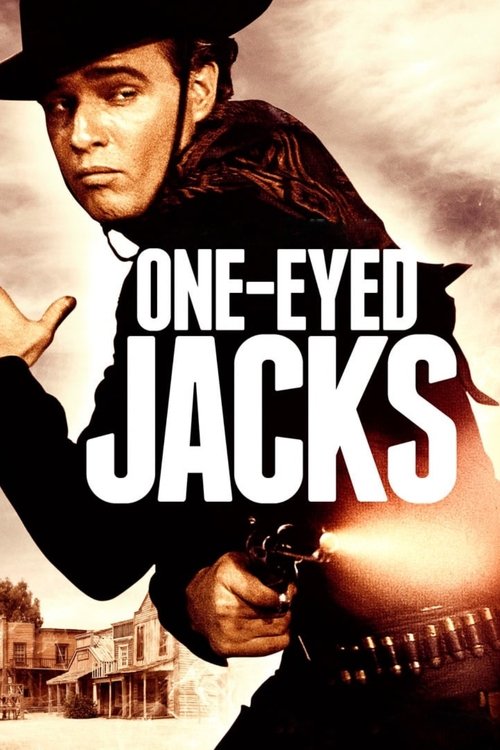





_**One of the GREAT Westerns**_ Dad Longworth (Karl Malden) abandons his young partner in crime, Kid Rio (Marlon Brando), leaving him to face imprisonment in Mexico. Five years pass before Rio escapes and seeks retribution. He finds Dad living a respectable life as Sheriff in Monterey, California, with a Mexican wife (Katy Jurado), a step-daughter named Louisa (Pina Pellicer), and seemingly the fulfillment of the American Dream along the Pacific coast. Complicating matters are two criminals who team up with Rio to rob the town bank (Ben Johnson and Sam Gilman) and Rio’s developing feelings for Louisa. “One-Eyed Jacks” marks Brando's sole directorial effort, though his original version was significantly longer (!). A director’s cut has been shown on television, but this 141-minute edition is perfectly acceptable. This film isn't just one of the finest Westerns ever made; it also stands among Marlon Brando's best performances. What elevates it? Several factors contribute. While Brando delivers a captivating performance, the story itself is equally compelling, even if it leans more toward a slow-paced drama than an action or adventure film. When action does occur, it feels swift and authentic. The narrative explores several recurring themes. One central idea concerns the conflict between someone who doesn’t fit in and conventional society. Since society often consists of people trying to conform, those who don't must adapt if they want to succeed. Essentially, fitting into mainstream society requires concealing past problems and presenting a respectable image – something Dad Longworth has mastered and is determined to protect. I feel some sympathy for Dad Longworth; though abandoning Rio was wrong, one can understand his reasoning. Returning for Rio would have carried substantial risk of capture or death. His choice offered the safest path toward a better life, free from his criminal past. He clearly desired a stable job and family, knowing time wasn’t on his side. The problem is that the past has a way of resurfacing, which is another theme woven throughout the film; Rio's return threatens Dad’s carefully constructed American dream. The intensity of Dad’s anger when he brutally beats Rio reveals his desperation to bury the ghosts of his past, explaining his attempt to have Rio hanged on false charges later in the story. Love and redemption are also intertwined. Both Dad and Rio are criminals seeking a better life; Dad finds it through his wife's love and the support of Monterey’s residents, while Louisa’s affection gradually transforms Rio. By the film’s end, he desires only to escape with his sweetheart, rather than continue his cycle of violence. Without this transformation, "One-Eyed Jacks" wouldn't be nearly as impactful a film. Dad’s love for Katie, his Mexican wife, also provided an opportunity for Katie and Louisa “from the beanfields,” as he puts it. Loyalty is closely linked to love, exemplified by Rio’s dependable Mexican sidekick, Chico (Larry Duran). A key strength of "Jacks" is its refreshing realism; there's no silliness, unbelievable one-liners, exaggerated action sequences, or dated elements—aside from the opening credits and score. Fortunately, the rest of the film avoids those pitfalls. “One-Eyed Jacks” served as a clear influence on the Spaghetti Western genre. Like Eastwood’s characters, Rio is an anti-hero. The main distinction between “Jacks” and most Spaghetti Westerns lies in "Jacks'" compelling story and its protagonist's potential for positive change within society. The film’s impact extends beyond just the Spaghetti Westerns; the crucifixion-style beating and subsequent recovery scene was essentially replicated in “Conan the Barbarian” (1982), a fact Arnold Schwarzenegger himself acknowledged. Pina Pellicer delivers a memorable performance as Rio's girlfriend, Louisa. Spiritually, her character is remarkable. Despite one regrettable mistake while intoxicated, she embodies love, virtue, and spirituality; again, this love proves pivotal in someone’s personal evolution. Sadly, Pina Pellicer took her own life a few years after “Jacks” was released. We are fortunate to have this film as a lasting tribute to her beauty and goodness. "Jacks" was filmed entirely in California, with coastal scenes captured on the Monterey Peninsula, including Pebble Beach. It's one of the few Westerns that showcases the Pacific Ocean (it also appears briefly at the beginning of 1954’s “Garden of Evil”). Other filming locations include Big Sur and Death Valley. GRADE: A
On September 28, 2026
#5325▲ 1284
5325th by Pulse movie online43.3PULSEPulse MeterOur daily Pulse Meter measures public activity and popularity signals across the web.How it works →














