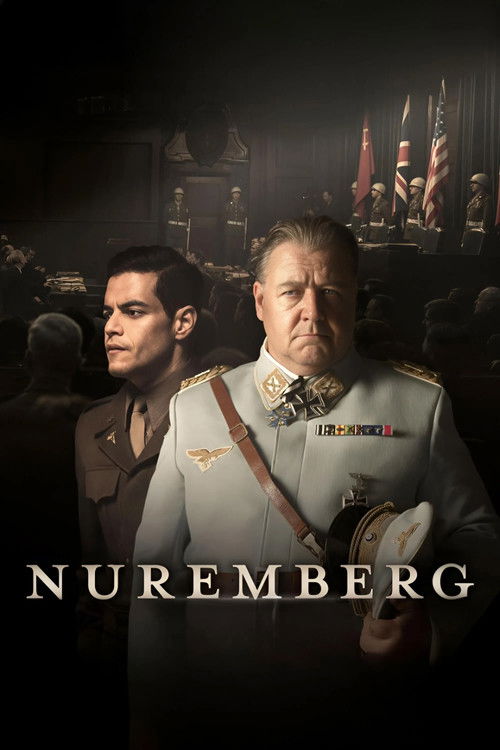





It's often said that those who fail to learn from history are doomed to repeat it—a piece of advice, unfortunately, that people frequently ignore. However, writer-director James Vanderbilt’s newest film reinforces this idea, particularly considering the current political and social environment. This compelling historical drama/psychological thriller delivers a strong warning about needing to recognize, accept, and seriously consider the lessons learned from the Nuremberg trials, where former Nazis were prosecuted for crimes against humanity following World War II—the first time proceedings of this kind had ever taken place. It’s important to note that this isn't a remake of the well-known 1961 film “Judgment at Nuremberg.” The movie focuses on the efforts of US Supreme Court Justice Robert Jackson (Michael Shannon) as he tries to establish an international court made up of judges from the Allied Forces—the United States, Great Britain, France, and the Soviet Union. During the first of what would be a series of 12 trials, the tribunal prosecutes 22 Nazi defendants, including Reichsmarschall Hermann Göring (Russell Crowe), who was second in command to Adolf Hitler. The Allies’ capture of Göring at the end of the war was a significant victory in their pursuit of justice, but to ensure he was fit to stand trial, the US military assigned psychiatrist Dr. Douglas Kelley (Rami Malek) to assess his mental state, which forms the core of the film's story—a narrative inspired by Jack El-Hai’s 2013 nonfiction book, The Nazi and the Psychiatrist. This process becomes both personal and professional as surprising insights emerge from their intense conversations. However, the film also exposes the narcissistic and sociopathic characteristics shared by Göring and his colleagues, traits that Kelley finds disturbing not just in the Nazis but also subtly present in others—a disheartening discovery for the idealistic doctor. I'm honestly puzzled by the reaction this film has received; it hasn’t been nominated for any of the major awards announced so far, despite its strengths in writing, editing, production design, music, and the excellent performances from the three leads, as well as supporting actors Richard E. Grant, John Slattery, Leo Woodall, and Colin Hanks. I also can't understand some of the criticisms that have been made. What others have called boring, I found captivating; what some considered a dry academic exercise, I thought was consistently engaging and deeply moving; and what some described as slow-paced, I felt was well-managed and kept my attention throughout its 2 hour and 28 minute length. From these criticisms, it seems clear that the American public generally isn’t interested in historical subjects, which is disappointing to me, especially given how often history repeats itself. As a college history major, I find this disheartening. The sentiment is perhaps best captured by a quote from British historian and philosopher R.G. Collingwood, shown before the credits: “The only clue to what man can do is what man has done.” "Nuremberg" demonstrates that point; let’s hope people are paying attention.
On September 28, 2026
#28962▼ 601
28962nd by Pulse movie online18.1PULSEPulse MeterOur daily Pulse Meter measures public activity and popularity signals across the web.How it works →