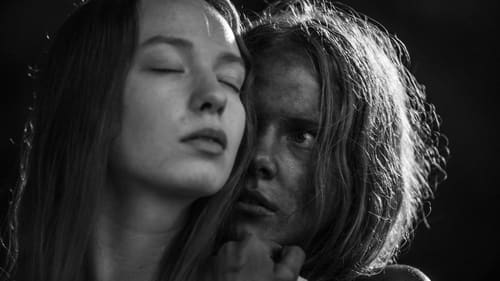





In reality, superstitious beliefs are logical fallacies, yet in a film like November, they can determine whether someone lives or dies, finds redemption or faces damnation. The characters within this Estonian-German fairy tale, reminiscent of Bergman’s work and written and directed by Rainer Sarnet, reside in a village bordering a genuinely haunted forest—though it would seem strange to them if the forest weren't haunted. To illustrate, deals with the devil are so commonplace that clever villagers trick him by substituting blackcurrant sap for blood when signing contracts. I find it peculiar that both All Movie and Wikipedia place the film in the 19th century, as it feels more like the Late Middle Ages, complete with the presence of the Plague. However, this is a world where almost anything seems possible—including deceiving death and the devil; one of these resourceful villagers comes up with an ingenious plan: “Take off your pants and put them on your head. The plague will think we have two butts and won't dare to touch us." It’s tempting to laugh at these seemingly naive peasants, but then the Plague, appearing as a white goat, genuinely passes them by—at least temporarily. The villagers use various survival strategies, which I’ll call ‘lifehacks,’ to endure the harsh winter; the most prevalent of these involves the kratt, which explains the frequent dealings with the devil. A kratt, originating from ancient Estonian mythology, is constructed from hay or old household items but requires a soul to carry out its master's commands. Villagers summon the devil at crossroads to negotiate: acquiring a soul for their kratt in exchange for their own souls later on. The trouble is that kratts are overly enthusiastic and capable of threatening their owners’ lives if they aren't constantly occupied; consequently, a kratt’s master might ask it to perform impossible tasks, like building a ladder out of bread. The primary function of the kratt in November is to engage the viewer, and in my case, it more than succeeded thanks to the film’s practical special effects. Hans (Jörgen Liik), who appears to be either exceptionally intelligent or not quite bright enough to survive, creates a snow kratt; there's no risk of it attacking him, but equally little chance that it will prove useful. Hans hopes his kratt will bring him a young baroness—the daughter of the local German baron—whom he adores; unfortunately, the Baroness isn’t a cow (kratts can only steal livestock or inanimate objects), and even if she were, this particular kratt is too fragile to accomplish such a feat. The sole benefit Hans derives from the situation is his kratt's extensive knowledge ("Where did you learn to talk like that, kratt?"; "Everywhere. I ran through ancient cities like a river, bubbling in splendid Gardens like a fountain, I fell like rain and carried countless ships. Now I am snow, and for the first time I have the ability to speak through the mouth you gave me, Master"). Considering this general situation, it’s unsurprising that a villager is caught scraping gold from a Christian altar; “Why did you scrape it?”; “You know that the altar is sacred. If I pay with it at the bar, the gold will go back to my pocket.” However, in an ironic twist, the peasant woman is mocked: “How will it come back? Walking?" The belief that "Jesus will bring it" back because "it's holy gold" exemplifies magical thinking just as obvious as wearing your pants on your head to outsmart the Plague; so why is one idea taken seriously and the other a source of derision? One explanation is that the notion originates from Latvia ("Latvians have an ass for a mouth and only shit comes out”), but there's something more complex at work. Sarnet doesn’t just contrast the Apollonian and Dionysian aspects of Christianity and paganism; he also reverses their physical and metaphysical roles.
On September 25, 2026
#16035▲ 4672
16035th by Pulse movie online27.1PULSEPulse MeterOur daily Pulse Meter measures public activity and popularity signals across the web.How it works →