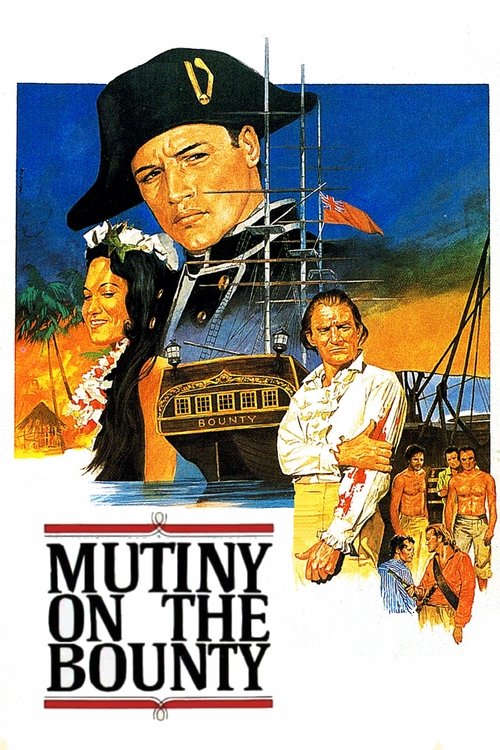





This 1962 adaptation of The Bounty story stands out as the most captivating and epic among the three versions available – the 1935 film with Clark Gable, this one starring Marlon Brando, and the 1984 release simply titled "The Bounty." The narrative centers on a true event: William Bligh’s mission in 1787 to collect breadfruit plants from Tahiti for England. The voyage was supposed to circle the globe but was diverted due to difficulties around South America, forcing an extended five-month stay in Tahiti. While there, most of the crew succumbed to the allure of the island's beauty and friendly inhabitants. Eventually, they had to resume their journey, but three and a half weeks later Fletcher led 18 mutineers in taking over the ship. Christian then set Bligh and his loyalists adrift in a small boat, subsequently establishing a new life with Tahitian companions on Pitcairn Island, a remote location largely unknown to British naval charts. While Mel Gibson’s version is more historically precise, this one excels in its scope and overall impact, despite its considerable three-hour length. The earlier black-and-white film feels dated and somewhat contrived by comparison. Certain historical details are altered for dramatic effect, but the core story remains faithful. For example, Fletcher's background explains his motivation for joining the mission; the missing cheeses incident highlights Bligh’s flawed judgment; and the crew’s inability to navigate around Cape Horn is portrayed accurately. The film also correctly depicts their lengthy stay in Tahiti, Fletcher’s infatuation with Maimiti, and the eventual burning of The Bounty on Pitcairn Island. It's noted that Christian did not die until several years after the mutiny. However, there are noticeable discrepancies: Christian was younger than Brando portrays him; Bligh and Fletcher had a prior relationship that isn’t shown in the film; the mutiny occurred at night rather than during daylight hours; and Fletcher's death wasn't caused by fire-related injuries. The performances of Marlon Brando as Christian and Trevor Howard as Bligh are particularly strong, showcasing their evolving relationship leading up to the rebellion. The film avoids portraying Bligh as a purely evil figure, unlike the 1935 version, acknowledging his flaws while suggesting his actions were driven by a sense of duty. It’s clear that Bligh's difficult personality and past mutiny in New South Wales stemmed from an arrogant and abusive nature. A powerful scene depicts Bligh and his loyalists adrift in their small boat, deciding to sail 3600 miles to Timor despite the lack of navigational tools. This desperate gamble, motivated by revenge, resulted in a harrowing 47-day journey with limited supplies, though all survived – a feat not shown in Gibson’s version. The film also provides insight into Christian's post-mutiny depression and the life that awaited the mutineers on Pitcairn Island—something absent from the other two versions. A few moments in the opening scenes feel somewhat artificial, and again, the omission of Bligh’s incredible voyage to Timor is a significant drawback. Despite these minor shortcomings, this version remains the most engrossing telling of the story, which I believe is a hallmark of a truly great film. Gibson's 1984 rendition is commendable as well, but lacks the same captivating quality. Watching both films consecutively is recommended. It has a running time of 3 hours and 16 minutes. GRADE: A
On October 3, 2026
#9459
9459th by Pulse movie online3.4PULSEPulse MeterOur daily Pulse Meter measures public activity and popularity signals across the web.How it works →