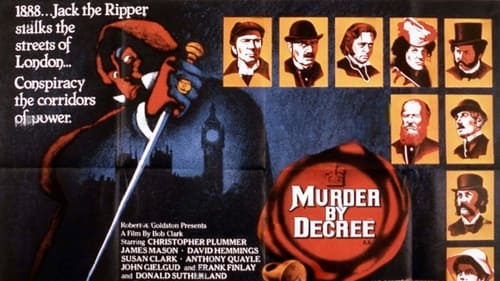





Bob Clark directed Murder by Decree, which John Hopkins adapted from Elwyn Jones and John Lloyd’s novel, The Ripper File. The film stars Christopher Plummer, James Mason, David Hemmings, Susan Clark, Frank Finlay, Anthony Quayle, Donald Sutherland, Geneviève Bujold & John Gielgud. The movie places Sherlock Holmes (Plummer) and Dr. Watson (Mason) in the pursuit of Jack the Ripper within Whitechapel, London, in 1888. “I’ve been exploited, old fellow, by the very people for whom we are searching,” one character observes. Pairing Britain's most infamous serial killer with the greatest detective is an idea that had already been explored in a 1965 film called A Study in Terror. While that earlier effort didn’t quite succeed, Murder by Decree benefits from a larger budget and a more polished feel. It truly works! Within the Sherlock Holmes universe, this film functions similarly to how On Her Majesty's Secret Service does for the James Bond series. It stands apart, a divisive work not due to technical flaws or poor quality, but because the central character displays humanity—a man of conscience, politically, socially and ethically. He remains the familiar, clever, and intricate figure audiences know and love, but Murder by Decree presents him as a human being, with Watson portrayed as a sensible companion who contributes meaningfully to the investigation while retaining sensitivity. The strength of the film lies in these characterizations, brought to life by two remarkably talented actors. “If she dies and you come under my hand? Expect no mercy.” The production design is impressive, which is essential for a Jack the Ripper-themed movie. There’s an abundance of darkness, smog, and Victorian costumes (designed by Judy Moorcroft). The action unfolds on dimly lit, cobbled streets, with sets evoking the grime and despair of London's slums. Crucially, the story itself is compelling; it proposes a spectacular, albeit fanciful, Ripper theory. Ranging from a secret love child to connections within the Freemasons and even Royalty, the notion presented is powerful. While speculative, those responsible for the film deserve credit for successfully blending Arthur Conan Doyle’s creations with historical elements—something A Study in Terror failed to accomplish. The supporting cast also delivers solid performances; Hemmings, Quayle, Finlay, Gielgud and Bujold all shine, with Bujold having a particularly impactful scene within an asylum setting. The only disappointment is Sutherland's role. His character, Robert Lees, appears briefly for what seems like a significant contribution to the plot, but ultimately doesn’t deliver. It feels more like an excuse to dress him up in a macabre fashion and add some ethereal touches to the film. Plummer delivers a truly magnificent performance during the finale and the big reveal of the Ripper. He commands attention before his peers, including the Prime Minister (Gielgud), as he reveals the explanation with passionate conviction; it’s then that you realize this was always intended to be a Sherlock Holmes movie first and foremost. It ranks among the best featuring the Baker Street sleuth. 9/10
On September 24, 2026
#11773▼ 1102
11773rd by Pulse movie online34.2PULSEPulse MeterOur daily Pulse Meter measures public activity and popularity signals across the web.How it works →