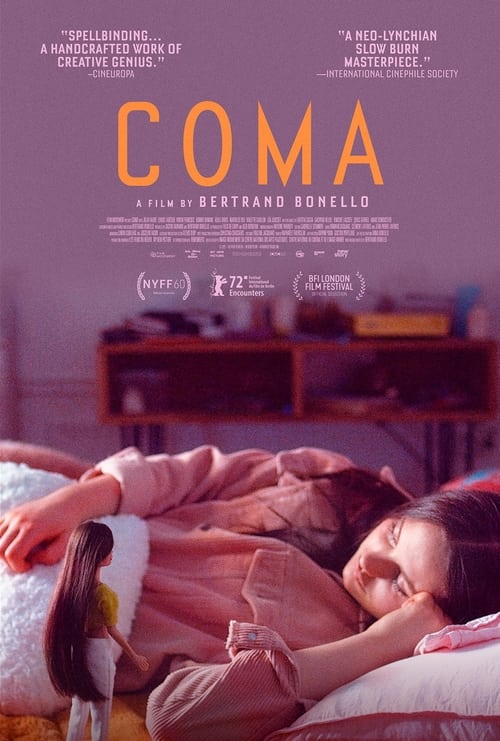




Coma initially presents itself as a product of the COVID-19 pandemic, a notion confirmed by director Bertrand Bonello in text appearing onscreen. This premise connects to his earlier film, Nocturama, through shared themes concerning rebirth. The movie concludes with similar textual reflections on existing between states – life and death, day and night – delivering a message of "hope, even in the darkest nights," accompanied by unsettling visuals depicting environmental damage. Patricia Coma, the central figure, acts as a guide for an unnamed teenage girl—an intentional omission highlighting her representativeness; she could be anyone who experienced pandemic-related isolation. Patricia is portrayed as both a novice influencer and skilled manipulator, particularly regarding the young girl, whom she symbolically represents the "Big Other" to. Through subtle cues, she instructs the girl to perform actions like sitting, crying, or daydreaming. She promotes “The Revealer” on her channel, claiming it hypnotizes users—framing loss as a form of victory—and supposedly enhances memory and encourages persistence. The teenage girl, heavily influenced, buys the device and remarkably never loses, even with her eyes closed. The structure of gaming allows for failure and correction, but The Revealer is designed to prevent errors, defying death and endings. Patricia Coma cautions her audience about its addictive nature—perhaps stemming from a desire to experience life without mortality’s limitations? Early in the film, the girl visits YouTube and watches one of Patricia Coma's videos. Looking directly at the camera, Patricia suggests that a better life requires less waking; a longer life is only possible within a dream. Prolonged dreaming deepens connection to the unconscious and repressed desires. From this point on, the girl retreats into fantasy as the real world has become unbearable due to the lockdown, necessitating escape through illusion. She arranges her dolls in a staged setting, and an ominous warning appears—a disembodied male mouth (possibly Gilles Deleuze?) cautions, "The dreams of others are extremely dangerous... Never get caught in someone else's dream." Even so, the dream world can become overwhelming. Earlier, the girl begins to write an email to an unknown recipient: “In my dreams, I hold you…” but deletes it before finishing—a resistance against returning to illusion. Imagining embracing a lost person—be it a brother, father, or lover—would mean reliving trauma, which is so painful that she prefers reality, however difficult, over the dream state. Drawing on Lacanian theory, dreams can be traumatic and intolerable, prompting us to wake up because even harsh realities are easier to bear than repeating tragedy. The dolls in Coma function as shadows of the characters, representing suppressed emotions—crying, laughter, rage, sadness, and even sexual desire—allowing the teenage girl to experience them indirectly. A striking scene depicts Scott and Ashley, siblings, engaging in sexual intercourse after a curfew alarm sounds during lockdown. Ashley expresses her deteriorating mental state before they seek comfort from each other. Both reality (the lockdown) and illusion (dreams) have become unbearable, leading to a temporary solution: action—a liminal space between realities. Ashley and Scott’s encounter isn't driven by conventional desire but is instead an act of rebellion against their confinement. Slavoj Zizek once observed, "We have sex to escape the overwhelming force of a dream that would otherwise crush us." Coma was my introduction to Bertrand Bonello’s work; I chose it initially because of its short length rather than the FIPRESCI prize it received at Berlinale. Nevertheless, it challenges viewers and can leave many feeling depleted and discouraged. Despite this, Coma confronts the trauma of the pandemic—a shared experience that the film seeks to revive. By immersing the audience in distressing imagery of solitude, depression, and loss – anxieties that persist today—it provides a controlled environment within the cinema to lessen the impact of these images. This process allows us to reclaim those memories, diminishing their power. As Bonello states at the beginning of his film, Coma is ultimately about “rebirth.”
On October 4, 2026
#62804
62804th by Pulse movie online1.3PULSEPulse MeterOur daily Pulse Meter measures public activity and popularity signals across the web.How it works →














