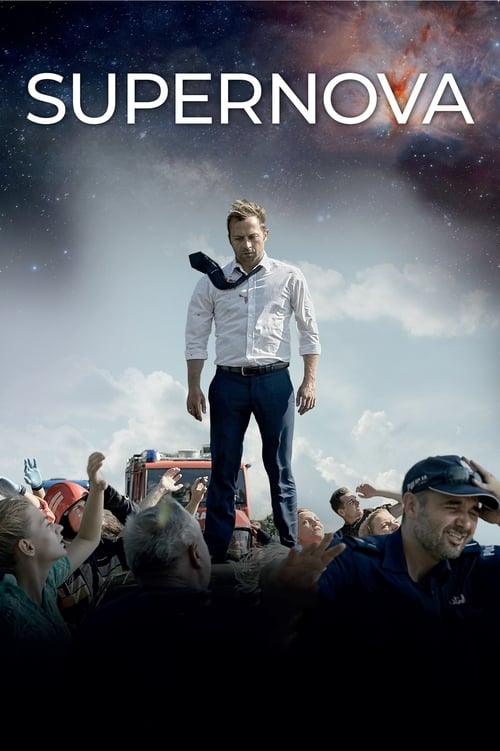




Bartosz Kruhlik’s _Supernova_ is a remarkably well-crafted debut feature that manages to explore numerous complex themes within its brisk 78-minute runtime; these include fully realized characters, intricate plot developments, social and political commentary, philosophical reflections, and a concluding scene that casts everything in a new light. The film begins on a Sunday morning in an unspecified rural area of Poland. We are introduced to Iwona Matys (Agnieszka Skibicka) and her two young children as they leave their home, pursued by her husband, Michał (Marcin Zarzeczny). It quickly becomes clear that Iwona is leaving him, taking the children with her. As he struggles to keep up, Michał flags down a passing car driven by Adam Nowak (Marcin Hycnar), a self-important politician. During an interaction in the vehicle, Adam swerves and crashes, then flees the scene. Unaware of what has happened, Michał passes out nearby. Simultaneously, two police officers—Sławek (Marek Braun), a seasoned officer known for his composure, and his young, overly eager partner Młody (Michał Pawlik)—respond to the call about the accident. Upon arriving, Sławek is visibly shaken by the scene. Shortly after, Zygmunt (Dariusz Dluzewski), the efficient but cynical police chief, arrives with instructions to minimize any repercussions for Adam, who has since returned. However, as news spreads through the community, a crowd gathers, and when Adam’s role in the crash becomes known, thoughts turn toward retribution. As the police attempt to control the situation, Michał, Adam, and Sławek find themselves embroiled in circumstances that will profoundly affect them all. Kruhlik utilizes the site of the accident as a symbolic microcosm, examining issues such as group mentality, political arrogance, abuse of power, alcoholism, the challenges faced by law enforcement, and the unsettling tendency for people to record tragedies before offering help. The central themes revolve around the spread of collective anger—the “Supernova” representing the build-up of emotion destined to erupt—and the idea that a life-altering event for one individual can be as inconsequential as a traffic delay for another. While Michał, Adam, and Sławek experience devastating upheaval, others simply face minor inconveniences. The onlookers, initially driven by morbid curiosity, soon become aggressive as they learn of Adam’s actions and suspect he may use his position to avoid accountability. This anger then spreads rapidly through the group, with each person influencing those around them. Kruhlik handles this escalating tension thoughtfully, drawing viewers into an increasingly dangerous and unpredictable situation. One of the film's strengths is the depth of character development achieved within such a short work. We gain considerable insight into the three main characters, as well as others like Młody and Zygmunt, and even Magda (Anna Mrozowska), a young policewoman struggling to react to unwanted attention from several youths. The screenplay’s structure is straightforward—deliberately so, given the film's low budget—but this simplicity doesn’t detract from its thematic richness or exploration of inner lives. The cinematography by Michał Dymek is also noteworthy, employing extended takes that make effective use of the single location’s geography. For instance, the opening shot begins at the Matys home and follows them down the road before settling on Michał as he falls asleep in a ditch. Coupled with the film's near real-time pacing, this creates a sense of immediacy akin to a documentary. Overall, I found _Supernova_ to be an impressive first effort. While not overly ambitious, it is skillfully made and offers some interesting observations about fate and how we are all naturally inclined to view ourselves as the central figures in our own realities.
On October 4, 2026
#245157
245157th by Pulse movie online0.1PULSEPulse MeterOur daily Pulse Meter measures public activity and popularity signals across the web.How it works →