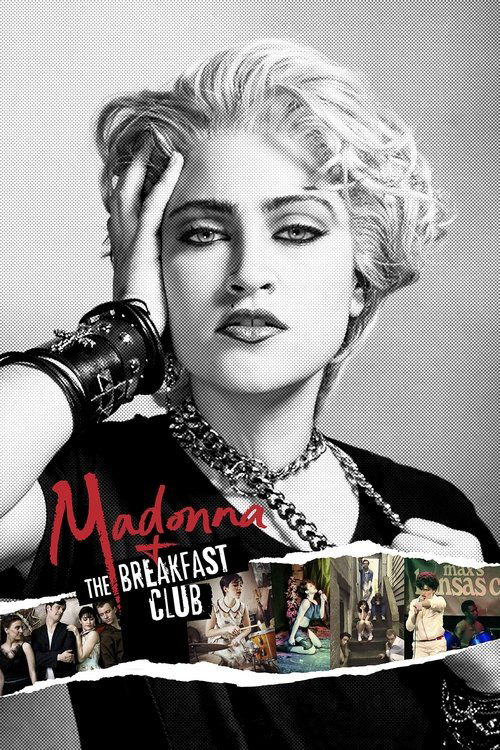




The film *Madonna and the Breakfast Club* presents itself as a look at Madonna’s early days as an aspiring musician in New York with her first band. However, it unfolds more like a twisted fantasy—a patriarchal revenge narrative that offers a disturbing interpretation of the Madonna-Prostitute complex. The interviewees, all men, depict the singer shifting between being portrayed as a vulnerable creature – likened to a squirrel or baby bird while composing songs – and a manipulative sexual figure who requires constant male attention. Aside from the narrator, there’s only one other woman shown in the film; apparently Madonna lacked female friends. The portrayal suggests she manipulates men against each other. Dan Gilroy, a former vocalist for the Breakfast Club, is particularly negatively portrayed. Much of the footage includes photos and video clips recorded by Gilroy during his romantic relationship with Madonna, which gives the impression that he has never moved on from her—a situation likely detrimental to his subsequent relationships. No woman appreciates a former partner holding onto mementos, especially if that ex is Madonna. The content of these recordings is remarkably unremarkable, preserving trivial questions like “why are rats ugly and mice not?” The only conceivable reason Gilroy kept them was to repeatedly listen to her voice during lonely evenings. However, the most unsettling obsession belongs to writer/director Guy Guido. In 1978, Madonna posed nude for a photographer out of financial necessity; Guido recreates these sessions, even bringing back the photographer who insists his photos were “statuesque” and devoid of sexual content. Nevertheless, Guido’s portrayal objectifies the actress playing young Madonna (Jamie Auld), reducing her to a prop—comparable to Elaine's mannequin on *Seinfeld*. It’s perplexing why these previously published images in *Penthouse* and *Playboy* needed recreating. The film isn’t one of those that relies heavily on reenactments, complete with narration like "She was ready to go. She was ready to move on. She wanted to go to New York," accompanied by stock airplane footage. The explanation is simple: the movie exists solely to humiliate and ridicule Madonna in any way possible. The film fabricates not just her words but also her thoughts. According to the narration, “Madonna, as a teenager, attended ballet school. Her teacher, Christopher Flynn … guided her and introduced her to art and culture beyond suburban Michigan. He also convinced her that she was special and beautiful, words unfamiliar to her and ones she needed to hear." How does Guido know Madonna didn’t feel these things? Of course, he doesn't; however, the implication is that she suffered from low self-esteem—a claim no one will challenge because it’s unlikely Madonna would appear in such a poorly made film. Ultimately, the movie seems to convey "I may be just a minor figure in Madonna's career, but I did sleep with her," or "Madonna didn't want to participate in my documentary, but that doesn’t matter because I have my own version of Madonna that I can exploit whenever I choose.” It’s deeply pathetic.
On October 4, 2026
#165823
165823rd by Pulse movie online0.1PULSEPulse MeterOur daily Pulse Meter measures public activity and popularity signals across the web.How it works →