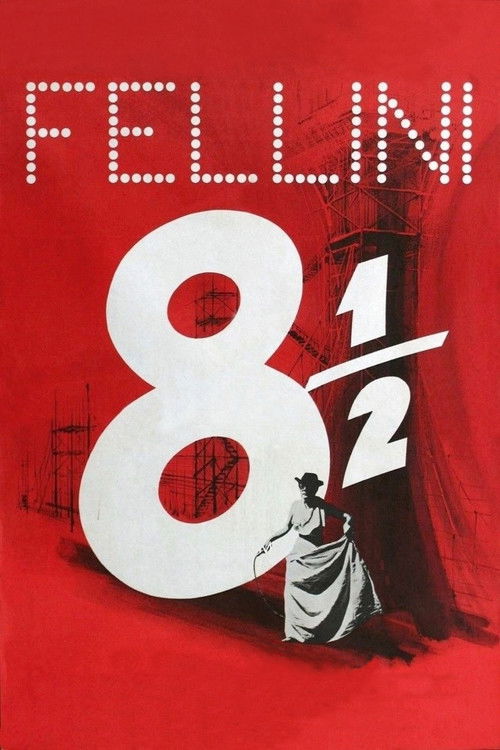





Considered a landmark achievement in cinema, Federico Fellini’s 8½ is an elusive film exploring equally intangible themes. It's a purposefully chaotic depiction of attempting to find meaning within chaos and functions as a creative triumph centered on artistic failure. The movie examines significant moments in one man's life while acknowledging its inability to fully explain their importance. True to its original working title, The Beautiful Confusion, 8½ is a bold and remarkable technical accomplishment that channels the story of an artistic crisis into something profoundly sweeping and uniquely personal. Marcello Mastroianni returns under Fellini’s direction following his award-winning performance in La Dolce Vita, portraying Guido, a film director experiencing creative block and constant distraction from completing his latest semi-autobiographical project. Caught between avoiding his mistress (Sandra Milo) and disappointing his wife (Anouk Aimée), Guido spends time reflecting on the past, seeking answers, and retreating into fantasies. The narrative smoothly transitions between Guido’s dreams and memories, blurring the lines between reality and imagination. Claudia Cardinale plays the character named Claudia—a fitting choice given her legendary status—who appears particularly ethereal, generally appearing briefly in Guido's visions as the woman intended to represent purity, innocence, and redemption within his film. The story is, in a way, disorganized but brilliantly constructed, skillfully highlighting the mysteries and uncertainties of life and the human mind. Characters appear unexpectedly and vanish quickly because the narrative remains confined to the edges of Guido’s existence; their actions are less important than the impressions they create—they're simply elements contributing to the fabric of the filmmaker’s inner world. Guido’s perspective aligns completely with his own self-absorbed view, seeing everyone he encounters as supporting characters in his life rather than fully developed individuals with complex histories. He lacks awareness of how his actions affect others and underestimates how transparent he is, failing to recognize when people perceive his deceptions and evasions. His wife, Luisa, seems particularly perceptive regarding Guido’s dishonesty. The film's choice of protagonist and its title (8½ representing Fellini’s count of the films he had made at the time) make it clear that this was intended as a deeply personal work from the director. However, if Guido’s lackadaisical filmmaking is meant to mirror Fellini’s own exhaustion, it's evident that the director regained his creative energy during production. Each shot appears meticulously planned and each cut precisely timed, creating a seamless flow like an extended monologue. Fellini uses every frame effectively, filling backgrounds with rhythmic movement and captivating set design. His carefully controlled camera creates seemingly limitless space, expanding rooms through mirrors and establishing distinct layers within crowded environments. This may be the pinnacle of Fellini’s celebrated career as a director. 8½ remains one of those rare films that have been highly influential (more recent examples include Charlie Kaufman's Synecdoche, New York and Paolo Sorrentino’s The Great Beauty) while remaining entirely unique. Even Fellini himself never created another work so skillfully blending irony with sincerity, surreality with relatability, and ambiguity with insightfulness—though one instance proved sufficient. This richly detailed film is designed to be endlessly rewatched, enjoyed, and contemplated. Ultimately, the final paradox of 8½ is that it undermines itself: when a great director isn’t sure what kind of film he wants to make, he creates a masterpiece.
On October 3, 2026
#3346▲ 210
3346th by Pulse movie online5.0PULSEPulse MeterOur daily Pulse Meter measures public activity and popularity signals across the web.How it works →