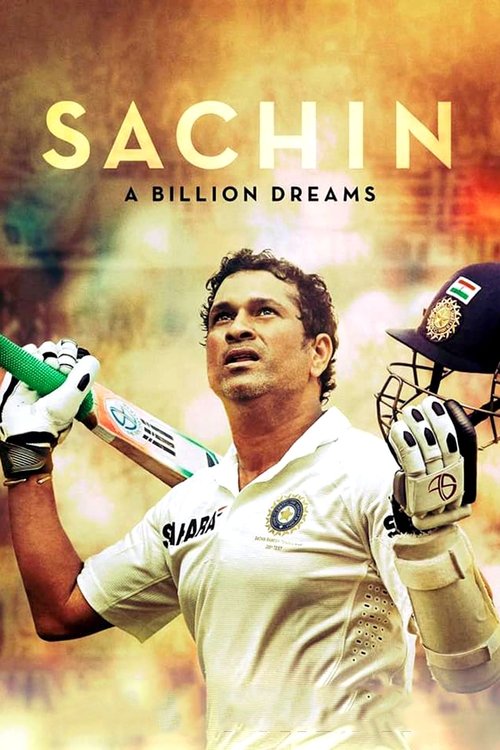




**The Face of Three Generations of Indian Cricket.** Documentary films don’t typically find a large audience in the Indian film market. However, there's an exception—and that has to be cricket, specifically Sachin Tendulkar. It's easy to forget how incredibly diverse India is: countless languages, ethnicities, religions, and social strata often divide people. Yet, one thing unites those across north, south, and northeast India: their passion for cricket. The '83 World Cup marked a new beginning, but Sachin was the key factor in sparking a revolution within Indian cricket. Recognizing this opportunity, the governing body rebranded itself around his presence. Because of him, Indians began to watch and learn about cricket; it became a religion, and he, a godlike figure. This is the second biographical sports film I’ve seen about Indian cricket, following 'M.S. Dhoni: An Untold Story'. I appreciated that this one wasn't presented as a traditional feature film. Feature films tend to be commercialized, with parts cut out, storylines altered, and characters changed—not to mention the inevitable inclusion of forgettable music tracks common in Indian productions. It’s difficult for actors to truly embody real-life achievers, which is why I often question how someone can win an Oscar simply by depicting a person who faced hardship and achieved success in the real world. So, kudos to the filmmakers for handling this story with such care. You could consider it a prequel to that Dhoni film. Not just because both films center on cricket or Indian cricket, but because they ran parallel to each other, connected in a way. They focus on different individuals, and this one began his journey roughly a decade earlier. Many athletes begin their careers with an unexpected opportunity that guides them toward a suitable path; it could be anything from a badminton racquet to a chessboard or even just a pair of shoes. For Tendulkar, it was a cricket bat given by his older sister. He was a mischievous boy until he received that bat. With the support of his brother, he started taking the sport seriously, and everything changed for him over the next 27 years of his life. At age eleven, he first picked up that bat. Five years later, he became the youngest player to represent his nation, against their biggest rivals on their home ground. I don’t recall those early moments because I was just a baby then. But six years later, I joined a fanbase of one billion people. I wouldn't call myself a Tendulkar fan—I’ve always respected him alongside others like Dravid and Dhoni. They demonstrated not only good sportsmanship but also fundamentally reshaped the game. Regardless of whether you are a Tendulkar fan, his batting is enjoyable to watch. There were many legends before and after him, but he carved out a unique place for himself that will be remembered for generations to come. > ❝India played themselves into a situation that was not uncommon in those days. If Tendulkar out, India is out.❞ Being young gave him an advantage, but captaincy brought its own struggles. Anyone who grew up in the 70s, 80s, and 90s would understand why. The match-fixing scandal emerged in the late 90s. I remember my first World Cup, which was held in England in '99, and a difficult event surfaced during that time. Even I felt emotional watching that part of this film; seeing those clips I’d watched eighteen years ago with added context was incredibly moving. A true hero. But the film wasn't just about celebrating his achievements; it focused on his life journey through cricket, allowing viewers to see everything he saw and experience what his teammates achieved alongside him. The storytelling jumped between World Cups like checkpoints, showing how his cricketing and personal life evolved every four years. Because he began his career at a young age, he witnessed many teammates come and go—generation after generation of players contributing to the sport’s revolution. During his final days, it was the T20 era, a time of fearless cricket. Having experienced numerous ups and downs, he left behind an inspiring legacy for future Indian cricketers; even today's legends like Dhoni and Kohli have credited him as a source of inspiration. They recreated his boyhood with actors, primarily in the initial scenes to establish a solid foundation. I imagine they lacked video footage from that period. Tendulkar was born into an average middle-class Indian family, but once his cricketing career began—and he gained popularity, at least within the Mumbai region—that became a turning point. Especially after that remarkable innings with Vinod Kambli. I wondered where Sudhir Chaudhary was. Anyone familiar with Indian cricket knows who he is. He did appear briefly, but I had hoped for a more substantial mention. Overall, my experience was positive, though listening to the dialogue and even the real clips in Tamil translation felt a little odd—nothing major, however. They omitted the IPL portion, similar to Dhoni’s film, to create a unified national narrative. One of the best aspects of that league was how his batting was celebrated by fans from opposing teams; India united behind him when franchise-based regional rivalries were at their peak. The film ran just over two hours and provided a detailed biography. If you're an Indian cricket fan, you’ll surely enjoy it. Even if you are a cricket fan from overseas, there’s no reason to miss it. It's a must-see for anyone who loves this sport or wants to learn more about it. _10/10_
On October 3, 2026
#104071
104071st by Pulse movie online0.5PULSEPulse MeterOur daily Pulse Meter measures public activity and popularity signals across the web.How it works →














