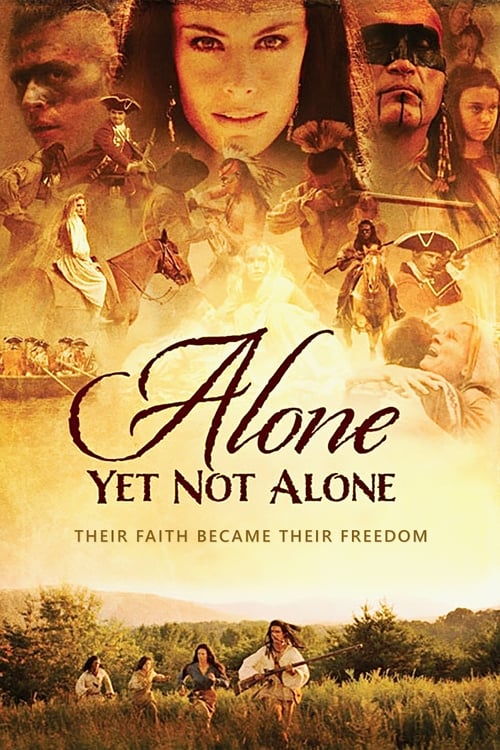





The story unfolds during the early years of the French and Indian War in 1755, centering on a German settler family whose lives are disrupted when they’re attacked by Delaware Indians in central Pennsylvania. Two daughters and a friend are taken captive, and their experiences over the next ten years are portrayed against the backdrop of ongoing conflict. The film poses questions about whether they will adapt to their circumstances, meet an unfortunate end, or manage to escape. "Alone Yet Not Alone" (2013) draws from the true account of Barbara & Regina Leininger and Marie LeRoy, who were captured during the Penn's Creek Massacre. Its atmosphere and style are similar to "The Last of the Mohicans" (1992), though with a smaller budget and a less intense tone, more akin to “Battle of the Brave” (2004) or "The Sign of the Beaver," also known as "Keeping the Promise" (1997). While some of the scenes depicting family life feel overly sentimental and I would have preferred a more realistic approach reminiscent of "Last of the Mohicans,” much of the film successfully captures a similar feeling, with comparable locations, costumes, and set designs. The initial family-focused moments recall the beginning of “How the West was Won” (1962), which ultimately proved to be an enjoyable Western. Don’t let the gentle tone of the opening scenes bother you; give it some time and you'll likely appreciate what follows. The film is rich in American historical detail, even if certain elements are exaggerated, such as General Braddock’s arrogance toward the Native Americans. While a more subtle portrayal would have been preferable, Braddock was indeed pompous and made critical errors in judgment regarding his troops and his adversaries, ultimately leading to his downfall near Fort Duquesne (present-day Pittsburgh). It's commonly believed that he was shot by one of his own men to clear the way for George Washington to assume command. The depiction of the Lenape people is well done; they are shown as resilient individuals accustomed to wilderness living and skilled warriors. They initially intended to ally with the British, but Braddock blocked this possibility. Criticisms regarding the film's religious aspects seem unwarranted given that Puritan pioneers in the 1600s and Pietist Lutheran settlers of the 1700s were deeply religious. Entire congregations migrated to America seeking freedom from religious persecution in Europe, along with their families. Fortunately, the faith element isn’t overwhelming; it’s present but not constantly emphasized. The film's pastor, Henry Muhlenberg, is presented as the founder of the Lutheran Church in America, a fact noted in the credits. His son, Frederick, later became a minister and served as both the first Speaker of the House of Representatives and the first signer of the Bill of Rights in 1789, which was ratified into law by eleven states after its passage. His brother also signed it. I feel that the production would have benefited from additional funding to allow for revisions that could have strengthened the narrative and clarified certain points. For example, I struggled to recognize that the dark-haired protagonist in the second half (Kelly Greyson) is actually Barbara, portrayed with blonde hair in the first part (Natalie Racoosin), a confusion not helped by their differing appearances. Similarly, the older versions of Owen and David are significant in the final act, but they lack sufficient backstory; we don’t know them well enough. It would have been more impactful to develop their characters further before the attempted escape, which would have made that sequence much more emotionally engaging—because you need to care about the characters to be invested in their journey. Despite these shortcomings, there is a lot of merit to this film and it’s worth watching for those who enjoy the previously mentioned movies and are interested in American history, provided they're comfortable with historically accurate depictions of Christian faith. The movie runs one hour and forty-two minutes and was filmed in Roanoke & Williamsburg, Virginia; Fort Loudon State Historic Park, Vonore, Tennessee (the fort); and Transylvania County, North Carolina (the final fight sequence). GRADE: B-/B
On October 3, 2026
#29108
29108th by Pulse movie online2.2PULSEPulse MeterOur daily Pulse Meter measures public activity and popularity signals across the web.How it works →