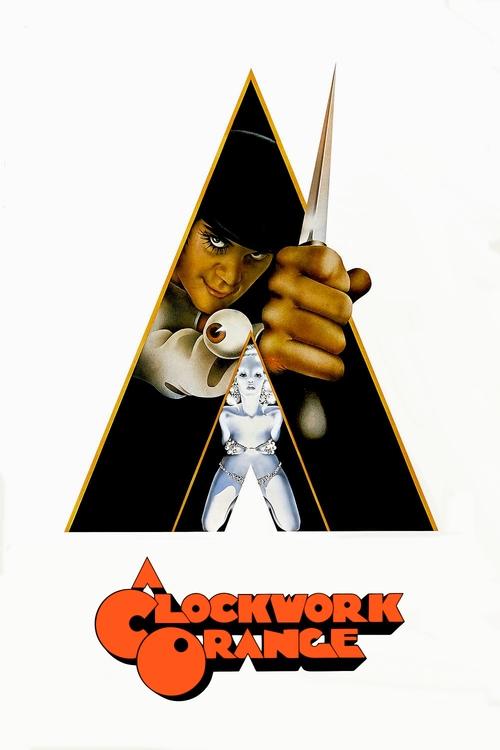





The movie is adapted from Anthony Burgess’ novel about a young man named Alex Delarge and his gang, who engage in acts of violence and mayhem. The dialogue uses a unique, futuristic language—a blend of Russian, slang, and invented words called Nadsat—designed to prevent the speech from sounding dated. Eventually, viewers will likely grasp what people are saying. **Note: This might be confusing if you haven’t seen the film yet, so it's best to read this afterward.** Alex enjoys violence, sex, and Beethoven. He leads a group of friends and in one typical evening, they attack an elderly man, break into a writer’s home, beat him up, and force him to watch his wife be assaulted—a moment that leads the writer to coin the term “A Clockwork Orange.” Afterward, they head to the Korova Milkbar. We see Alex's house: his parents are unremarkable and passive. His bedroom is modern, complete with a pet snake and a high-quality stereo system for listening to Beethoven’s Ninth Symphony. There’s conflict within the gang, which Alex responds to with violence. After asserting his dominance, he and his friends go on another destructive spree, during which Alex kills a woman before being trapped by his own companions. He's arrested and sentenced to 14 years in prison. Two years later, due to government overcrowding issues, a new technique is introduced—the Ludovico Technique—which makes offenders feel ill when they experience violent urges. Alex volunteers for this treatment hoping for an early release. Following the two weeks of treatment, we witness a demonstration that highlights its effectiveness, performed in front of his former prison guards and chaplain, who objects to the procedure on moral grounds, arguing it removes free will. Alex is released. Returning home, he finds his belongings have been seized, his snake has died, and another person is renting out his room. Homeless and without possessions, he encounters two of his old friends who seek revenge. He’s beaten and injured, then taken in by the writer whose wife he assaulted—the writer having since died, reportedly as a result of the assault. Initially not recognizing Alex (who was masked), the writer eventually realizes who he has sheltered and plots revenge while also aiding those opposed to the government's methods of prisoner rehabilitation. Stripped of his ability to defend himself, Alex becomes a victim. His survival isn’t surprising, given that he narrates the story; having narrowly escaped death at the hands of his previous victim, the government intervenes to reverse his treatment and restore his capacity for violence. It's hard to understand now what caused such controversy when the film was first released. While there are scenes of brutality and rape, they’re not as extreme as what can be found in many contemporary films, and often rely on suggestion rather than explicit depiction. The fact that it is available on DVD suggests a shift in societal standards for acceptability. As with all Stanley Kubrick's movies, this one is meticulously crafted, featuring a soundtrack of futuristic synthesizers (courtesy of Walter Carlos, who has since transitioned), classical music, and even “Singin’ in the Rain”—the song Alex sings during the assault on the writer’s wife. It’s a well-made film that explores themes of free will versus protection, the limits of rehabilitation, religious arguments about removing choice, and political maneuvering—as well as satire directed at those who believe divine intervention will always provide answers. There's also commentary on the relationship between the press and those in power, how the media can be used as a tool against the government, and a critique of the belief that science holds all the solutions—a central theme reflected in the film’s title: “–The attempt to impose upon man, a creature of growth and capable of sweetness, to ooze juicily at the last round the bearded lips of God, to attempt to impose, I say, laws and conditions appropriate to a mechanical creation, against this I raise my sword-pen —.“ I would recommend seeing the film.
On October 3, 2026
#400▼ 35
400th by Pulse movie online11.8PULSEPulse MeterOur daily Pulse Meter measures public activity and popularity signals across the web.How it works →