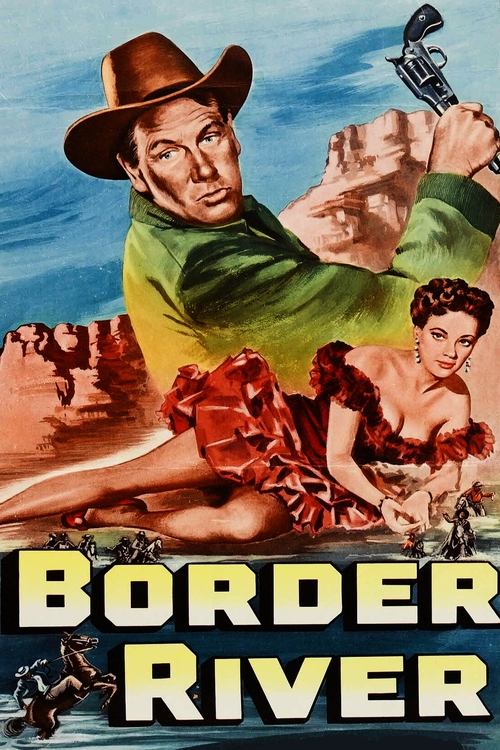




George Sherman directed Border River, with a screenplay from William Sackheim and Louis Stevens. The film stars Joel McCrea, Yvonne De Carlo, Pedro Armendariz, Alfonso Bedoya, and Howard Petrie; Joseph Gershenson composed the music, and Irving Glassberg was responsible for the cinematography. The story unfolds during the conflict between Maximillian and Juarez in 1865, centering on Zona Libre, a “Free Zone” territory situated on the Mexican side of the Rio Grande River. This area was controlled by a man calling himself General Eduardo Calleja, who made it a refuge for those avoiding the law. The film’s narrative is ostensibly about Zona Libre. However, the introductory statement is misleading because the movie's plot revolves around Zona Libre itself. It features McCrea as a Confederate soldier who has concealed stolen gold bullion within the territory. His plan involves safeguarding this gold to purchase Henry Repeater rifles, intended to support the Confederacy and prolong the Civil War. Naturally, numerous individuals in Zona Libre become interested in discovering the location of the hidden gold... A line from the film reads: "Never saw a Southern boy yet didn't have a lily sprouting out of his liver." Border River is an incredibly frustrating Western. The initial concept—a lawless zone populated by criminals and Civil War operatives—holds significant potential, but it isn’t exploited to its full extent. Instead, the screenplay focuses on having McCrea’s Clete Mattson navigate standard plot devices: protecting gold from others while pursuing the affections of a local woman. What's particularly disappointing is that this is one of those rare instances where the film favors a Southern protagonist; most Western enthusiasts appreciate some balance regarding the Civil War in genre films. The frustration is compounded by the impressive technical credits associated with the production. Irving Glassberg consistently delivered high-quality work as a cinematographer for various Westerns, and he does so here, showcasing the Utah landscapes beautifully in Technicolor. Similarly, Joan Joseff’s costume design for De Carlo is remarkable; she has never looked quite so striking before 1954, and Glassberg's color lenses enhance her appearance to a dazzling degree. The action sequences are inconsistent, which is irritating because Sherman is capable of staging effective set pieces, and when McCrea leads a Western film, one expects more dynamic action. Unfortunately, such moments are scarce, though McCrea once again demonstrates his skill as a fighter. A standout scene involves McCrea and his horse becoming trapped in quicksand; the ensuing struggle for both man and beast to escape is well-executed—as is McCrea's (a skilled equestrian in real life) reaction after the incident. Armendariz and Bedoya seem to compete with each other in overacting, which ultimately proves entertaining and becomes a positive aspect of the film. Ultimately, as someone who enjoys Westerns, I find many appealing elements within this production, preventing me from rating it below average. However, I can’t wholeheartedly recommend it to fans of the genre, though I wish the writers had been dealt with by Henry Repeaters during filming. The score is 6/10.
On October 3, 2026
#36984
36984th by Pulse movie online2.0PULSEPulse MeterOur daily Pulse Meter measures public activity and popularity signals across the web.How it works →