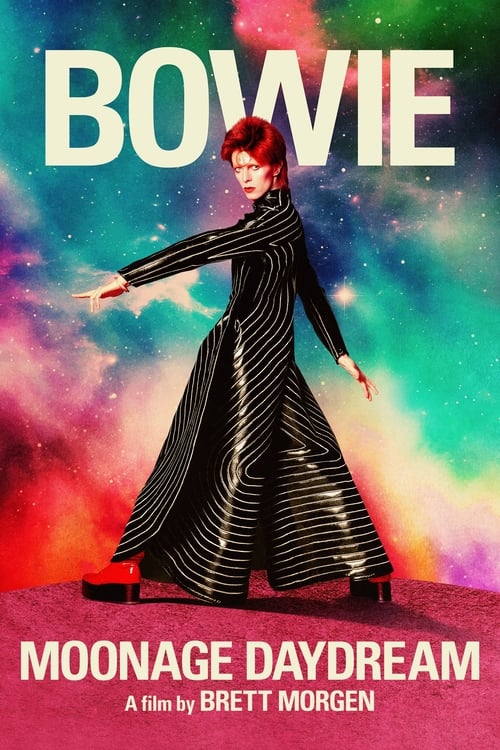





The film isn’t really about David Bowie, or even David Jones; it’s Bowie presented within quotation marks—intended as a mirror so the audience can see their own Bowie and reflect on their lives. Brett Morgen told NME in 2022 that for him, the most exciting aspect is the possibility of seeing a film about David Bowie and learning how to be a better parent or lead a more fulfilling life, not just hearing details like his studio collaborations with Freddie Mercury. Do you recall the David Bowie biopic "Stardust," released in 2020? It was heavily criticized by fans, its wider release was impacted by Covid-19, and it received overwhelmingly negative reviews. I tracked it down during its limited run and let’s just say...it's not good. There was very little music included (none of which Bowie wrote!), proving to be a failure in every respect. In my initial review, I pointed out that no one involved seemed to truly understand what David Bowie represented or stood for. Duncan Jones, filmmaker and David Bowie’s son, warned fans upon the trailer's release: “If you want to see [this] biopic [made] without [...] the families blessing, that’s up to the audience.” His father had previously expressed his desire against having a film made about his life, most notably with 1998's "Velvet Goldmine," which initially starred Jonathan Rhys Meyers as David Bowie before the script was altered to focus on a Bowie-inspired rocker. I wasn’t aware of “Moonage Daydream” until I saw its striking trailer in the theater. Directed by Brett Morgen, who also directed the intimate Kurt Cobain documentary "Montage of Heck," the film came about after Morgen met with David Bowie in 2007 to discuss similar ideas—a meeting that ended with both men criticizing each other’s work. The project was revived following Bowie's death in 2016, leading to years spent sifting through his extensive film and music archive, uncovering over five million pieces of media. Now, "Moonage Daydream" is playing in theaters worldwide this weekend. As the first film endorsed by the Bowie Estate, it’s been called “the greatest rock film of the decade” by Esquire Magazine. I traveled roughly three hours to see the film twice in IMAX, which was available for only one week and as recommended by Director Morgen. I agree that the film is best experienced in IMAX; seeing it in a standard theater might diminish the impact. The film begins with a black screen as David Bowie’s voice resonates through the speakers, delivering a monologue about time. "One of the most complex expressions," he says. We are then plunged into a compilation of silent film footage accompanied by the 1995 electronic track “Hallo Spaceboy.” It's an enthralling introduction to what becomes a hypnotic experience. The fast-paced editing style doesn’t let up, and while I found it enjoyable, it was also somewhat overwhelming. There are no new interviews or footage; instead, Bowie narrates and stars through edited lines and clips from past film appearances and concerts. Surprisingly, the film incorporates discussions about philosophy and religion, which I found intriguing—hearing how his thoughts and opinions evolved over time, all set against a vibrant montage of visuals. The film truly captures Bowie’s essence in both its cinematography and sound design. Every song used, whether live or recorded in the studio, was remixed/remastered by Bowie's longtime collaborator Tony Visconti, and they all sound fantastic. The companion album, "Moonage Daydream - A Film by Brett Morgen," features some interesting deconstructed mixes, like “DJ” and “Modern Love,” which are worth checking out. Hearing elements of songs I’d never heard before—clear as day in IMAX—was truly mind-blowing. There are moments with strikingly beautiful visuals; my favorite was a mature David Bowie from the 90s staring at himself as a child while "Space Oddity" plays during what appears to be an empty room, which is revealed to be a concert performance – it gave me chills and excitement. However, the film lacks direction, plot, or narrative—it's essentially very little of anything. Morgen addressed this criticism in conversations with CREEM Magazine and DEADLINE: "My hope [is] that people would experience the film the same way they listen to a Bowie album. We don’t learn about David [...], we learn about ourselves. What can I offer that you can’t get in Wikipedia?” Because there's no timeline, the viewer is left feeling disoriented—which is quite off-putting. To be honest, "Moonage Daydream" frequently feels incomprehensible; that’s why I saw it twice. Unfortunately, it didn't help. It felt far too long, and cutting 30 to 45 minutes (or more) would have improved it. The film also fails to cover or highlight key moments, such as the making of and footage from the iconic "Blackstar" album (there are only a couple of clips from anything after 1990) and has just one three-second clip from “Labyrinth.” It’s odd that "Moonage Daydream" would mention David Bowie's guest role in a Spongebob Squarepants episode before addressing his starring role in a major motion picture or any song from "The Best of Bowie." It feels like being questioned by an overzealous member of r/DavidBowie about something I should already know. I believe that many musician movies released over the past decade are intended to introduce a new generation to established talent, and this film doesn’t (seem to want to) do that. This review is adapted from my writing for RSURADIO.com.
On September 29, 2026
#28314▼ 3207
28314th by Pulse movie online1.5PULSEPulse MeterOur daily Pulse Meter measures public activity and popularity signals across the web.How it works →