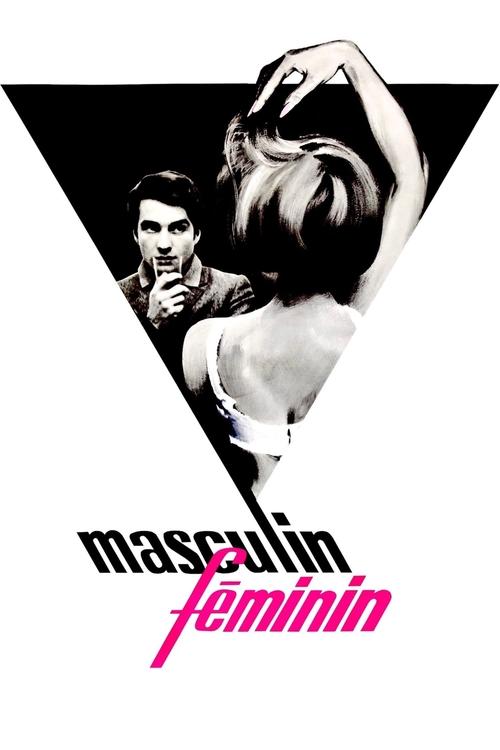





Jean-Luc Godard examines enduring patterns of courtship and dating between young men and women in *MASCULIN FEMININ*, a 1965 production, exploring how these interactions played out within the evolving, prosperous French society of the 1960s. Paul (Jean-Pierre Léaud), age 21 and recently discharged from national service, begins a conversation with Madeleine (Chantal Goya), a friend of a friend, under the guise of seeking employment assistance. Their relationship develops, and the film follows its difficulties as Paul finds himself the only male among Madeleine and her female companions, Elisabeth (Marlène Jobert) and Catherine-Isabelle (Catherine-Isabelle Duport). He occasionally reconnects with his friend Robert (Michel Debord), who is similarly young but already deeply involved in union activism. However, this extends far beyond a simple romance. Godard incorporates numerous social, political, and cultural themes from the 1960s into the narrative. Paul and Robert are both committed to the French Left, while the women demonstrate more interest in consumerism—pop music, fashion, automobiles. Their dialogues reveal Godard’s own anxieties regarding societal changes of that era, including concerns about political suppression, rapid technological advancements, and a working class seemingly too busy to enjoy its newfound purchasing power. Throughout the film, characters overhear conversations in public spaces which are extreme in their depictions of sex and violence, yet they also expose underlying social tensions. Notably, Godard unexpectedly includes an interview with a real young woman (Elsa Leroy), recently recognized as "girl of the year" by a fashion magazine. Léaud questions her about politics, war, and her aspirations. During this six-minute segment where she appears alone on screen, visibly uncomfortable, she seems unaware of global events like the Vietnam War. As someone with an interest in 1960s European youth culture, I’ve observed that *MASCULIN FEMININ*, like other works, demonstrates the continued relevance of those issues today. Because Godard's regular cinematographer Raoul Coutard was unavailable for this project, Willy Kurant stepped in. Although their collaboration reportedly involved disagreements, Kurant delivers some impressive extended shots, transforming a story about young people and relationships into a visually compelling experience. The film’s sound design is also noteworthy, featuring natural audio from the café locations and occasional gunfire sounds. *MASCULIN FEMININ* isn't as widely celebrated as other Godard films of that period. It could be considered a less significant work due to its reuse of elements from previous productions while still seeking new directions. This repetition isn’t necessarily negative, though; the formal techniques (tableau divisions, an abrupt conclusion) borrowed from *Vivre sa vie*—and other earlier works—function effectively within this story's context. I initially found the ending confusing and how it was reached, but with further reflection, its impact is more apparent.
On October 3, 2026
#12093
12093rd by Pulse movie online3.1PULSEPulse MeterOur daily Pulse Meter measures public activity and popularity signals across the web.How it works →