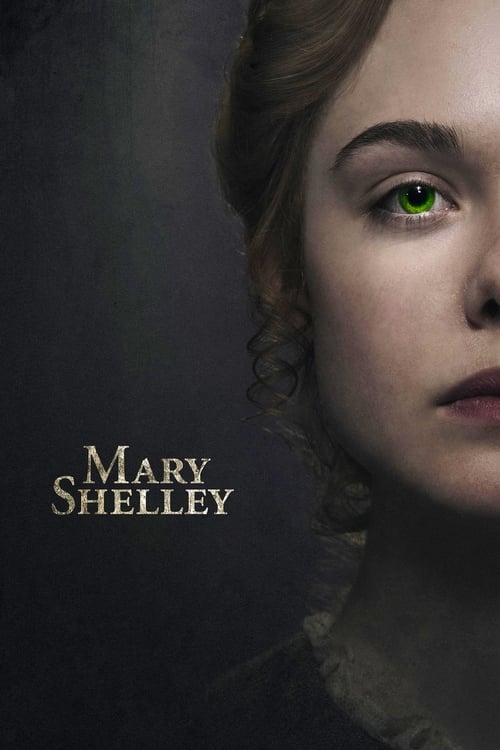





I really wanted to dislike this film! When I settled in to watch _Mary Shelley_, I anticipated frustration, because while it gets some facts correct, it misses many key points, and the overall theme feels disjointed. As someone who works in English studies, I expected to find serious flaws. Many people I know who’ve seen it—both academics and others—have expressed strong dislike for it, and I found myself agreeing with their criticisms; there are moments when the film is simply laughable. Yet, despite all that, while I certainly didn't love it, nor did I hate it. In fact, I ended up enjoying quite a bit of it, which surprised me! Let’s start with the basics. Directed by Haifaa Al-Mansour (_Wadjda_), and written by Emma Jenson (credited alongside Al-Mansour), the film presents itself as a portrayal of the true story behind Mary Shelley's (Elle Fanning) first (and best) novel, _Frankenstein_ (1818). The promotional poster proclaims, "_Her greatest love inspired her darkest creation_." This is misleading; the writing of the novel occupies roughly twenty minutes near the end of the two-hour runtime. Instead, the film primarily focuses on a romantic relationship, beginning shortly before Mary Wollstonecraft Godwin and Percy Bysshe Shelley (Douglas Booth) first met in 1812, and concluding after the anonymous publication of _Frankenstein_ in 1819. The movie centers around the evolving relationship between Mary and Shelley. The story covers significant events from those seven years: Mary’s time with William Baxter in Scotland, where she met Shelley; her strained relationship with her father, William Godwin (Stephen Dillane); Shelley's unexpected visit to Godwin; the breakdown of Shelley’s marriage to Harriet Westbrook (Ciara Charteris); the conflict between Mary and her stepmother, Mary Jane Clairmont (Joanne Froggatt); Mary’s attempts to escape the influence of her deceased mother, Mary Wollstonecraft, author of _A Vindication of the Rights of Woman_ (1792); her friendship with her stepsister, Claire Clairmont (Bel Powley); their elopement and subsequent financial struggles; Shelley's beliefs about "free love"; the death of Mary and Shelley’s first child; the summer of 1816 spent with Lord Byron (Tom Sturridge) in Geneva; Mary’s friendship with Dr. John Polidori (Ben Hardy), and the unfortunate events surrounding his short story, “The Vampyre.” While most of the key events are present, there are numerous omissions, inaccuracies, and additions that feel out of place. For every aspect the film gets right, it seems to get more wrong. For instance, although it accurately portrays Shelley’s suggestion that Mary and Thomas Hogg become lovers, it fails to acknowledge that Mary wasn't entirely opposed to the idea and was actually close friends with Hogg, who she confided in. After her child died, she wrote to him: > _My dearest Hogg my baby is dead-will you come to see me as soon as you can. I wish to see you-It was perfectly well when I went to bed - I awoke in the night to
On September 30, 2026
#16419▼ 1471
16419th by Pulse movie online2.9PULSEPulse MeterOur daily Pulse Meter measures public activity and popularity signals across the web.How it works →