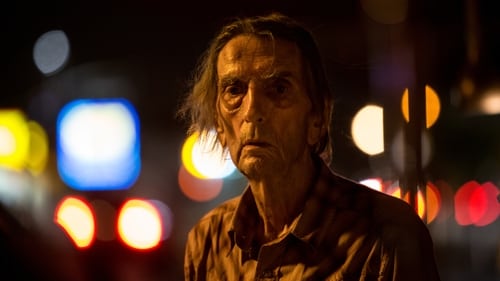





_A meditation on mortality_ The movie was created specifically for and deeply inspired by Harry Dean Stanton. The stories within the film are drawn from his life, making it a work fundamentally shaped by him. While _Lucky_ isn’t literally about Harry Dean Stanton, its narratives feel intrinsically connected to his experiences. This approach guided the filmmakers' efforts to ensure clarity and focus throughout the story. John Carroll Lynch’s directorial debut, _Lucky_, marks the last performance of the legendary Harry Dean Stanton, who was 90 years old during filming (prior to Michael Oblowitz’s as-yet-unreleased _Frank and Ava_). Stanton passed away two weeks before the film's US release. Written by Logan Sparks and Drago Sumonja—close friends of Stanton—the film explores themes of mortality, serving as much a portrait of Stanton himself as it does its central character. Initially resembling a quirky comedy populated with eccentric characters, the film gradually shifts to a more profound examination of how a nonagenarian atheist confronts the reality of approaching death. The film unfolds at a deliberate pace, exploring various themes including mortality, routine, impermanence, friendship, love, loss, regret, and hope. _Lucky_ is effective because it presents individual moments that collectively create something greater than their sum. The story centers on Lucky (Harry Dean Stanton), a 90-year-old man living in a remote town bordering an Arizona desert. An atheist who rejects the idea of an afterlife or soul, he’s happily unmarried and childless, content to state his solitude without feeling lonely—a sentiment borrowed from Michael Mann's _Heat_. His life is governed by a strict routine: yoga exercises, a walk to the local diner for conversation with owner Joe and waitress Loretta, completing the daily crossword puzzle. Visits to Bibi’s shop for cigarettes are followed by hours watching game shows at home. Evenings are spent at Elaine and Paulie's bar, sharing stories with his best friend, Howard (David Lynch), and bartender Vincent. After a sudden fall, his doctor, Christian Kneedler, explains that the body naturally deteriorates with age, though he finds no serious underlying issues despite Lucky’s smoking habit. Despite this, Lucky continues his routine, acutely aware of his limited time remaining. Over several days, he attends Bibi's son's birthday party, encounters a life insurance salesman, Bobby Lawrence (Ron Livingston), who he feels is exploiting Howard, and recounts experiences from the Battle of Okinawa with former marine Fred (Tom Skerritt). Essentially, that’s the plot—it's undeniably a character-driven film where conventional narrative elements are secondary. This is evident in the slow opening sequence depicting Lucky walking past deserted shops under a scorching sun. The deliberate pace and editing style mirror the lethargic atmosphere of the scene, allowing characters and moments to linger. This establishes the film’s tone and style. Instead of a traditional plot-driven narrative, _Lucky_ consists of small, often unusual moments linked by minimal connective tissue. None of the characters undergo significant personal transformations; Lucky remains fundamentally unchanged from beginning to end—which is precisely the point. The opening sequence also includes shots of the barren desert and a tortoise slowly moving into view, later revealed to be named President Roosevelt and belonging to Howard. This could have been a cliché, but it becomes an integral plot element when Roosevelt escapes, causing Howard distress. The missing tortoise highlights Howard’s character while Lucky's reaction offers him a chance for philosophical reflection. Lucky’s atheism is a key aspect of his personality; he rejects God, the afterlife, and the soul, believing that life ends with death. As he becomes more conscious of his mortality, this worldview appears less like a grumpy old man’s opinion and more like a source of potential unhappiness. The doctor emphasizes both the blessing and curse of living so long—blessed for reaching such an age, cursed by the physical decline it brings. A central theme is routine; Lucky's rigid schedule dictates his mood, and any disruption
On September 23, 2026
#8219▼ 346
8219th by Pulse movie online40.3PULSEPulse MeterOur daily Pulse Meter measures public activity and popularity signals across the web.How it works →