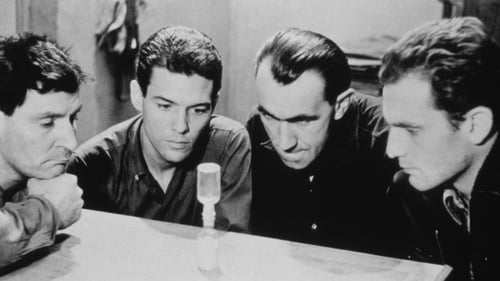





This week's Noir of the Week selection is Le Trou (1960), directed by Jacques Becker, which was released in the United States as The Night Watch. The 2 ½ hour prison escape film, similar to Rififi, employs lengthy, uninterrupted sequences, often without dialogue, to heighten the straightforward narrative about a group of prisoners attempting an ambitious breakout from their facility. Le Trou is presented in black and white and remains largely devoid of musical accompaniment until its conclusion. The story begins with one of the men who escapes, now outside the Santé Prison walls, introducing the events. The film then shifts back to a Paris prison setting in 1947. We are introduced to Claude Gaspard, a young man placed into a small cell shared by four other inmates. There he meets Volsselin, nicknamed Monseigneur, who is charming and always smiling. Also sharing the cell are Roland Darbant, the individual introducing the film, Geo Cassid, and Manu Borelli. The men work together in their cell assembling cardboard boxes. Gaspard discovers that his cellmates all receive generous care packages from outside contacts and share a close bond. What he doesn't realize is that they’re planning an escape. While retrieving a care package containing bread, butter, sausage, smoked fish, and rice pudding, the men debate whether to inform the new arrival about their plans. Eventually, Gaspard is brought into the confidence of the group and they begin the lengthy process of breaking through the floor. The men methodically chip away at the concrete floor, which leads to a sewer tunnel, over an extended period. The film avoids many familiar prison movie tropes. There are no overtly cruel guards, and all the prisoners seem like ordinary people. Director Becker, who passed away shortly after completing the film, utilized non-professional actors, including Jean Keraudy, who was actually involved in the 1947 escape attempt. Considering that the events depicted unfold over just three days, the remarkable persistence demonstrated by the prisoners is an impressive feat of filmmaking. The movie contains several memorable scenes, notably the noisy breaking of the concrete floor using a bed leg—shown in real time—while another prisoner peers through the peephole with a makeshift spyglass constructed from a toothbrush and a broken mirror. Watching this scene draws you in and makes you feel like a participant in the hacking, sawing, and picking. I won’t reveal the ending or any of the interesting plot developments, but it involves a heartbreaking betrayal leading to an unconventional conclusion. Young Gaspard finds himself bearing the brunt of an ironic twist at the film's end. It is a superb prison escape movie that shouldn’t be confused with the French New Wave movement occurring concurrently.
On September 23, 2026
#6773▼ 330
6773rd by Pulse movie online42.9PULSEPulse MeterOur daily Pulse Meter measures public activity and popularity signals across the web.How it works →